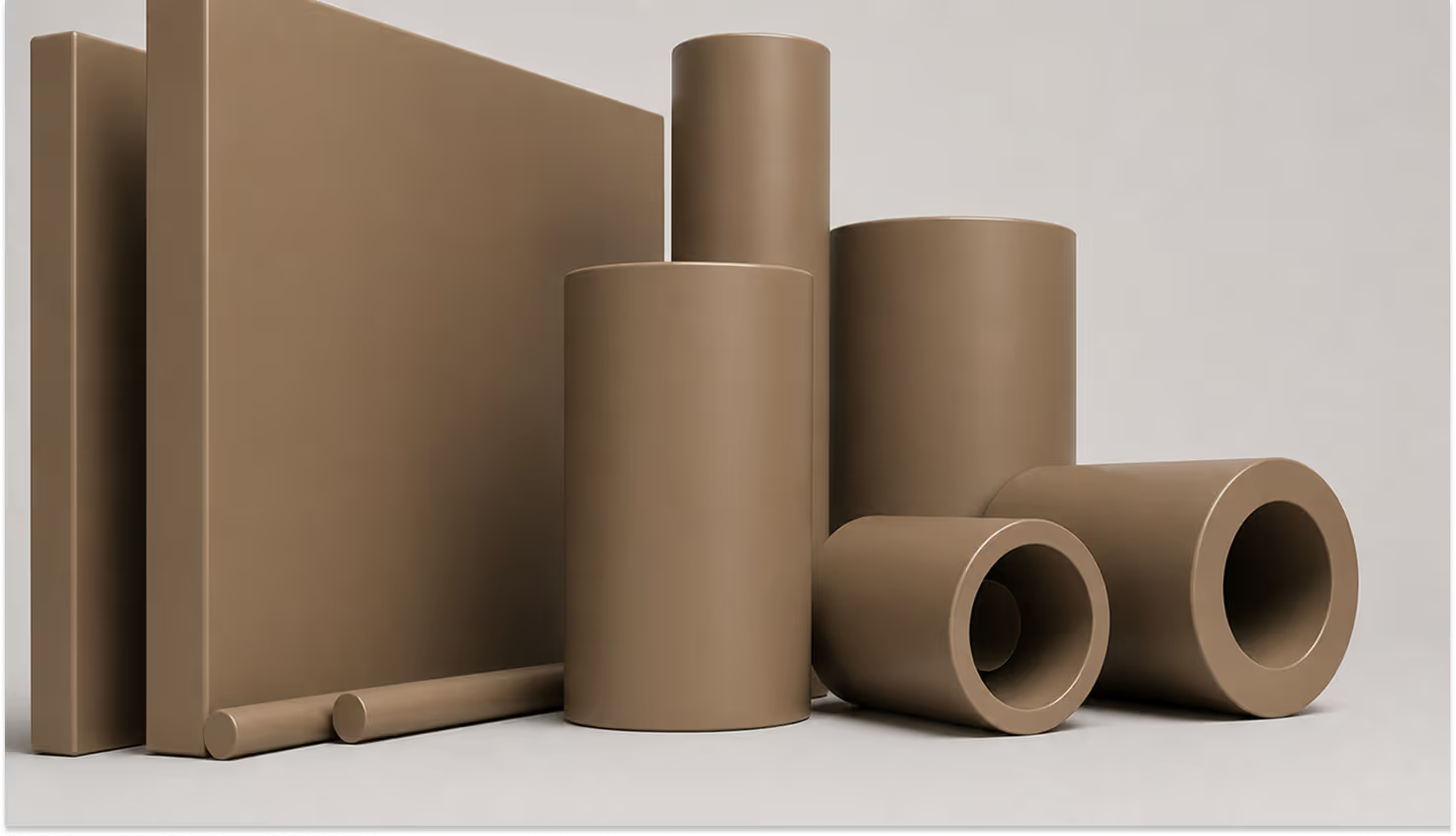
High-Performance Wear & Tribological Solutions
Self-lubricating engineering plastics designed to minimize friction and maximize component life in demanding dynamic environments. These advanced stock shapes are formulated with internal lubricants like PTFE, Graphite, and Carbon Fiber to eliminate the need for external grease, reduce "stick-slip," and provide exceptional wear resistance under high load and velocity (PV) conditions.
Key Highlights

Environmental Stability
Unlike many commodity wear plastics, these high-performance grades maintain their tribological properties and dimensional integrity in the presence of steam, chemicals, and extreme temperatures.
Non-Abrasive Protection
Soft-filler grades (like PEEK-20PTFE or AF DE588) provide a "gentle" wear interface, protecting expensive mating metal shafts (such as aluminum or unhardened steel) from scoring.
Elimination of Stick-Slip
Grades like Delrin 100AF are specifically designed to provide uniform friction, ensuring smooth, precise motion control in sensitive instrumentation and actuators.
Vibration & Noise Reduction
Superior internal damping properties compared to metal bearings, resulting in quieter operation and the elimination of "squeak" in oscillating or sliding assemblies.
Maintenance-Free Operation
Ideal for "lubricated-for-life" applications and dry-running environments where external oils or greases are prohibited or difficult to maintain.
High PV Performance
Engineered to withstand extreme Pressure-Velocity (PV) limits, allowing components to run at higher speeds and heavier loads without thermal degradation or surface melting.
Superior Lubricity
Integrated PTFE and graphite fillers create a self-replenishing lubricating film at the wear interface, significantly lowering the Coefficient of Friction (CoF) and preventing surface galling.
Quick Selection: Which Grade
| Material Grade | Dynamic CoF (Dry) | Limiting PV (psi⋅fpm) | Primary Advantage |
|---|---|---|---|
| Delrin AF13P (13% PTFE Powder) | 0.18 – 0.22 | ~8,000 | Economical general-purpose wear. |
| Delrin AF13 (13% PTFE Blend) | 0.15 – 0.19 | ~10,000 | Improved lubricity over powder grades. |
| Delrin 100AF (PTFE Fiber) | 0.08 – 0.12 | ~12,000 | Lowest "stick-slip" for precision motion. |
| AF DE588 (20% PTFE Fiber) | 0.10 – 0.14 | ~11,000 | Zero-swell; optimized for naval valve seats. |
| PPS - PTFE20 | 0.18 – 0.22 | ~18,000 | Chemical resistance with insulative wear. |
| PPS - BG (10/10/10) | 0.05 – 0.12 | ~40,000 | Extreme chemical/load wear workhorse. |
| PEEK - PTFE20 | 0.15 – 0.25 | ~20,000 | Clean, insulative, and high-temp capable. |
| PEEK - BG (10/10/10) | 0.05 – 0.15 | ~50,000+ | Absolute highest load/speed performance. |

| Challenge | Primary Recommendation | Why? |
|---|---|---|
| Highest Load & Speed | PEEK-10/10/10 BG | The triple-filler system manages heat and stress simultaneously. |
| Chemical Submersion | PPS-10/10/10 BG | Near-total chemical inertness with bearing-grade performance. |
| Electrical Insulation | PEEK-20PTFE | PTFE provides slip without the conductivity of carbon or graphite. |
Precision Material Selection, Simplified.
Interact with Sofie to match your project needs with the perfect material solution. From tailored recommendations to in-depth product specs, Sofie provides the data-driven expert guidance you need to move from design to production.

Need help determining which grade is the right choice for your application?
Share your part requirements, operating conditions, or material challenges and our technical team will guide you on grade selection, stock formats, and supporting documentation.
Frequently Asked Questions
PTFE Powder (Delrin AF13P): Uses small particles of PTFE. It is more economical and provides a very uniform surface finish. It is ideal for parts with very intricate machined details.
PTFE Fiber (Delrin 100AF/AF DE588): Uses high-aspect-ratio fibers. These fibers "orient" at the surface, creating a much more slippery interface. 100AF has significantly lower "stick-slip" (starting friction) than powder-filled versions.
Choose BG (10/10/10) if your part is under high mechanical load and running at high speeds. The carbon fiber provides the strength to prevent the bearing from "squishing," and the graphite helps dissipate the heat generated by friction.
Choose PTFE20 if the part must be an electrical insulator or if you are running against a soft metal like aluminum. The BG grades are electrically conductive and can be abrasive to soft shafts.
Delrin AF DE588 is unique because it uses a specialized Acetal base that has nearly zero moisture absorption. In underwater or high-humidity environments, standard Delrin might swell slightly, causing a valve to seize. AF DE588 stays dimensionally perfect and ensures the valve turns with very low torque even after years of submersion.
"Stick-slip" is the jerky motion caused when the static friction is much higher than the dynamic friction. It is a major problem in precision medical pumps and telescope mounts. Delrin 100AF is the industry leader in preventing this, as its static and dynamic coefficients of friction are nearly identical.
In most cases, no. These materials are "self-lubricating." Adding grease can actually be counterproductive, as the grease can trap abrasive dust and grit, which then acts like sandpaper against the plastic. However, in some heavy-duty start-up scenarios, a small amount of initial lubrication can help "seat" the bearing.
PPS - BG (10/10/10) or PPS - PTFE20. PPS is famously resistant to almost all acids, fuels, and solvents up to 400°F. If your wear part is submerged in aggressive chemicals or automotive fluids, PPS will outperform Delrin and PEEK in terms of chemical stability.
PEEK - BG and PEEK - PTFE20 are excellent for repeated autoclave cycles (steam).
PPS grades are also stable but can be more brittle.
Delrin grades should not be used in steam sterilization, as they can degrade (depolymerize) when exposed to high-pressure steam.
Safe for soft metals: Delrin AF13P, 100AF, AF DE588, PEEK-PTFE20, and PPS-PTFE20.
Abrasive to soft metals: PEEK-BG and PPS-BG. Because these contain carbon fiber, they require a mating surface hardened to at least Rc 35 to prevent the plastic from "machining" the metal shaft.
If you operate at a PV level close to the limit, the part's life will be short. For a long-lasting, "set-it-and-forget-it" component, engineers typically design for a Safety Factor of 2, meaning they choose a material with a Limiting PV that is double what the application actually requires.
Delrin AF13P or PEEK-PTFE20. These grades are easier to machine to very tight tolerances (+/−0.0005") because they don't have long fibers that can "fuzz" or cause dimensional jumping during the CNC process.