Delrin® 100AF | Maximum Lubricity for Heavy-Duty Sliding Components
Delrin® 100AF is a high-viscosity acetal homopolymer containing 20% PTFE fibers. It is the premium choice for machined parts requiring the absolute minimum friction and maximum wear life in non-lubricated environments.

What Delrin® 100AF offers
Performance characteristics that make Delrin® 100AF the gold standard for heavy-duty, dry-running sliding and bearing applications.

Superior Friction Reduction
20% PTFE fiber provides a coefficient of friction as low as 0.18, making Delrin® 100AF the lowest-friction grade in the Delrin® AF family. This helps reduce friction, heat buildup, and slip-stick in continuous sliding applications.

Exceptional Wear Resistance
High wear resistance supports longer service life in bearings, bushings, thrust washers, wear pads, and other components exposed to continuous sliding or rotating motion.

Dry-Running Self-Lubrication
PTFE fibers create a self-lubricating transfer film on mating surfaces, allowing Delrin® 100AF to operate reliably where external grease or oil is not suitable, including food processing, medical, and cleanroom applications.

High Load Capacity
A limiting PV value of up to 11,000 allows Delrin® 100AF to handle demanding combinations of pressure and velocity in sliding applications. This makes it well suited to high-load bearings, bushings, and thrust components.

Reliable Performance in Sliding Applications
The combination of low friction, high wear resistance, and low moisture absorption makes Delrin® 100AF suitable for precision bushings, thrust washers, cams, guides, and other components requiring consistent performance in continuous motion.

Common components made from Delrin® 100AF
Typical machined parts for heavy-duty, dry-running sliding and bearing applications.

Heavy-Duty Precision Cams
Motion transfer in automation, electronics, and medical devices.

Conveyor Guides and Sliding Rails
Directing high-speed movement in packaging or bottling lines.
Sliding Valve Seats and Seals
Critical components in fluid handling and pneumatic systems.

Wear Pads and Machined Wear Strips
Protective barriers in conveyor systems and heavy machinery.

High-Load Thrust Washers
Absorbing axial loads in rotating assemblies.

Industrial Bushings and Sleeve Bearings
The primary application for 100AF and AF13.
Delrin® 100AF Technical Properties

Delrin® 100AF rods, plates & tubular bars
Extruded stock shapes are supplied in standard diameters and thicknesses, with custom dimensions available for specific applications.
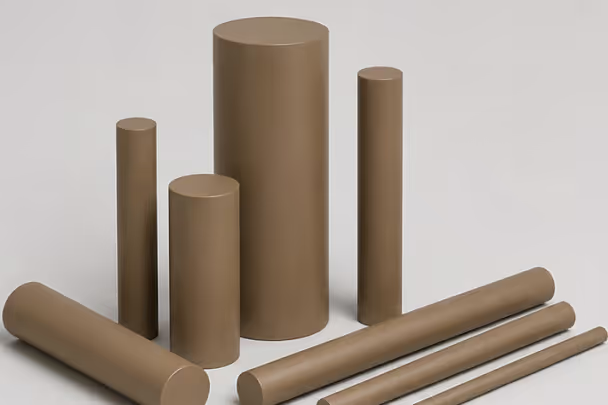
Rods
Extruded Delrin 100AF rods are supplied for precision bearing, sealing, and sliding wear applications requiring low friction, quiet operation, and excellent wear resistance. Rods are available in diameters from 3/4” to 10”.
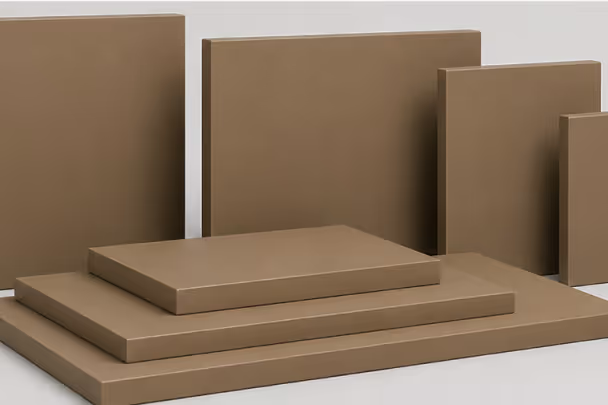
Plates
Delrin 100AF plates are supplied for machined wear pads, guide rails, thrust surfaces, and low-friction sliding components. Plates are available in thicknesses from 1/2” to 4”.
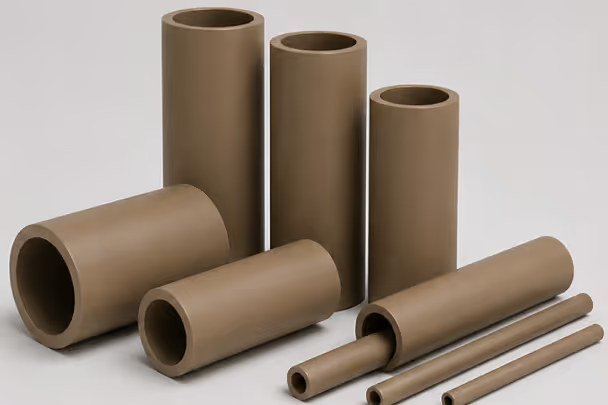
Tubular Bars
Delrin 100AF tubular bars are supplied for bushings, sleeve bearings, wear rings, and cylindrical wear components where low friction and machining efficiency are critical. Tubular bars are available from 4” OD to 12” OD with wall thicknesses from 1/2” to 1”.

Trusted by World's Leading Companies










How Delrin® 100AF compares to other Delrin® AF grades
Quick reference guide to help you choose the right Delrin® AF material for your application.
| Grade | PTFE Type | Friction (CoF) | Impact Strength | Primary Benefit |
|---|---|---|---|---|
| Delrin AF DE588 | 20% Fiber | 0.19 | 2.5 ft-lb/in (Tough) | Naval/Seal Grade: Conformable for watertight seals and high-shock environments. |
| Delrin 100AF | 20% Fiber | 0.18 (Lowest) | 0.8 ft-lb/in (Brittle) | Max Lubricity: Best for heavy-duty, slow-moving bearings with no lubrication. |
| Delrin AF13 (Blend) | 13% Fiber | 0.19 – 0.20 | 1.2 ft-lb/in (Mod) | The Workhorse: Best balance of wear life, strength, and machinability. |
| Delrin AF13P | 13% Powder | 0.22 – 0.25 | 1.1 ft-lb/in (Mod) | Economy Grade: Lowest cost for high-volume, low-load commercial parts. |
Need help determining if Delrin® 100AF is the right choice?
Share your part requirements, operating conditions, or material challenges and our technical team will guide you on grade selection, stock formats, and supporting documentation.
- Response within one business day
- Reviewed by our technical team
- No obligation or sales pressure
Frequently Asked Questions
While both are PTFE-fiber-filled acetals, Delrin 100AF contains 20% PTFE fiber for maximum lubricity. AF13 (AF Blend) is a mix containing 13% PTFE fiber, offering a balance of low friction and improved mechanical toughness/impact resistance.
Choose 100AF when your application involves continuous sliding or rotating motion where standard acetal would fail due to heat buildup or excessive wear. It is the preferred choice for eliminating "slip-stick" and reducing the coefficient of friction from roughly 0.35 down to 0.18.
Yes. The PTFE fibers create a self-lubricating transfer film on the mating surface. This makes it ideal for environments where external grease or oil is prohibited, such as food processing, medical devices, or cleanrooms.
Delrin 100AF is a rigid, hard material designed for high-load sliding. DE588 is a specialized naval grade that is more conformable (softer) and much tougher. DE588 is the industry standard for seals and gaskets, whereas 100AF is the standard for bushings and bearings.
Yes, it has a high limiting PV (10,000+), meaning it handles high pressure and velocity well. However, because 20% fiber content makes the material somewhat brittle, parts subjected to heavy shock or impact should use AF DE588 or AF13 (AF Blend) instead.
Moisture absorption is extremely low (<0.2%), similar to standard Delrin. This ensures that machined parts maintain their dimensional tolerances even in submerged or high-humidity environments.
Yes. Acetal is an excellent insulator. However, be aware that the PTFE fibers do not change its dielectric properties significantly; it remains a non-conductive material.
Delrin 100AF and AF13 are most commonly supplied as extruded rods, plates and tubular bars. Because 100AF is a high-viscosity resin, it is also available in thicker cross-sections than many other specialized plastics.
In many cases, yes. It is frequently used to replace brass, bronze, or stainless steel bearings to reduce weight, eliminate the need for manual lubrication, and provide quieter operation with superior corrosion resistance.