PEEK Bearing Grade for low-friction and high-wear machined components
Bearing-grade PEEK formulated with solid lubricants to reduce friction and improve wear performance. Designed for machined parts used in sliding, rotating, and dynamically loaded applications.

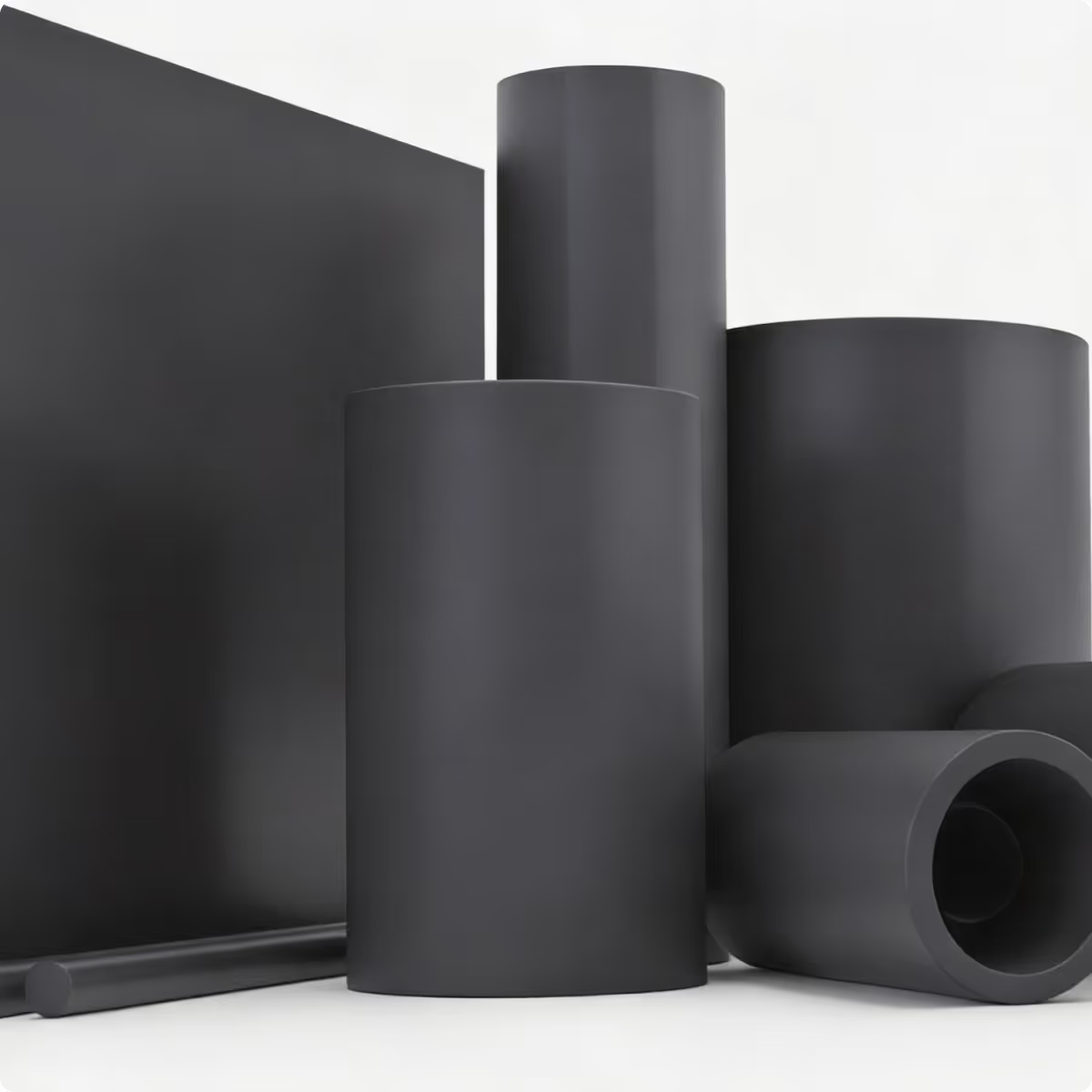
What PEEK Bearing Grade offers
High-performance characteristics that make PEEK bearing grade suitable for sliding, rotating, and dynamically loaded components.

Reduced friction in moving assemblies
Solid lubricant additives lower the coefficient of friction, improving performance in sliding and rotating components.

Improved wear resistance
Designed to handle continuous motion, reducing surface degradation and extending component life.

Stable performance under load and temperature
Maintains its wear and friction characteristics in mechanically stressed and elevated-temperature environments.

Reduced stick-slip behavior
Helps keep motion consistent in precision systems where smooth movement is critical.

Suitable for dry-running applications
Performs reliably where external lubrication is limited or not desirable.

Common components made from PEEK Bearing Grade
Typical machined parts that benefit from low friction and enhanced wear performance.
Rotating and reciprocating components
Used where lubrication is limited and dimensional stability must be maintained.

Gears and cams
Suitable for applications requiring controlled friction and wear resistance.

Valve seats and dynamic seals
Improves service life in fluid handling components with repeated movement.

Sliding guides and rails
Provides smooth, consistent motion in industrial and automation equipment.

Thrust washers and wear rings
Designed to reduce friction and surface wear under axial or radial load.

Bushings and sleeve bearings
Used in pumps, compressors, and mechanical systems with continuous motion.
PEEK Bearing Grade Technical Properties
| Property | Test | PEEK Bearing Grade | Unit |
|---|---|---|---|
| Tensile Strength | ASTM D638 | 14,500 | PSI |
| Tensile Modulus | ASTM D638 | 900 | KSI |
| Elongation @ Break | ASTM D638 | 30 | % |
| Flexural Strength | ASTM D790 | 20,000 | PSI |
| Flexural Modulus | ASTM D790 | 850 | KSI |
| Compressive Strength | ASTM D695 | 17,000 | PSI |
| Izod Impact (notched) | ASTM D256 | 1.2 | ft-lb/in |
| Hardness Rockwell | ASTM D785 | M90/R119 | — |
| Property | Test | PEEK Bearing Grade | Unit |
|---|---|---|---|
| HDT @ 264 psi | ASTM D648 | 590 | °F |
| Melting Point | — | 662 | °F |
| CLTE | ASTM E831 | 2.8 | in/in/°F × 10⁻⁵ |
| Thermal Conductivity | ASTM C177 | 2.5 | BTU·in/hr·ft²·°F |
| Property | Test | PEEK Bearing Grade | Unit |
|---|---|---|---|
| Dielectric Strength | ASTM D149 | 480 | V/mil |
| Dielectric Constant | ASTM D150 | 3.5 | — |
| Dissipation Factor | ASTM D150 | 0.003 | — |
| Surface Resistivity | ASTM D257 | 10¹⁵ | Ω/sq |
| Volume Resistivity | ASTM D257 | 10¹⁵ | Ω·cm |
| Property | Test | PEEK Bearing Grade | Unit |
|---|---|---|---|
| Coefficient of Friction (Dynamic) | ASTM D3702 | 0.15 | — |
| Wear Rate (K-factor) | ASTM D3702 | 8 | × 10⁻¹⁰ in³·min/ft·lb·hr |
| Property | Test | PEEK Bearing Grade | Unit |
|---|---|---|---|
| Specific Gravity | ASTM D792 | 1.45 | — |
| Water Absorption (24hr) | ASTM D570 | 0.06 | % |
| Flammability | UL94 | V-0 | — |

PEEK Bearing Grade rods, plates & tubular bars
Extruded stock shapes are supplied in standard diameters and thicknesses, with custom dimensions available for specific applications.
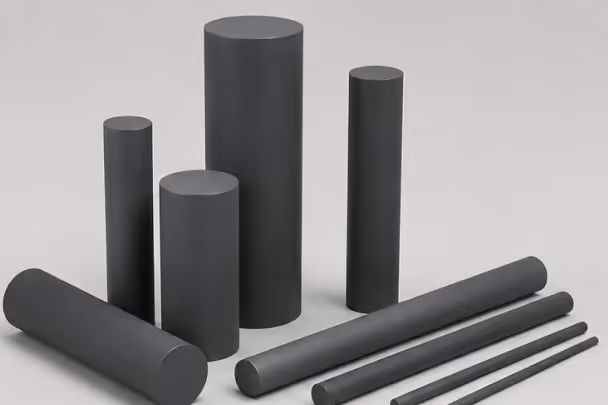
Rods
Extruded PEEK bearing grade rods are supplied for bushings, bearings, wear rings, and sliding components. Rods typically available from 3/8" to 8" diameter.
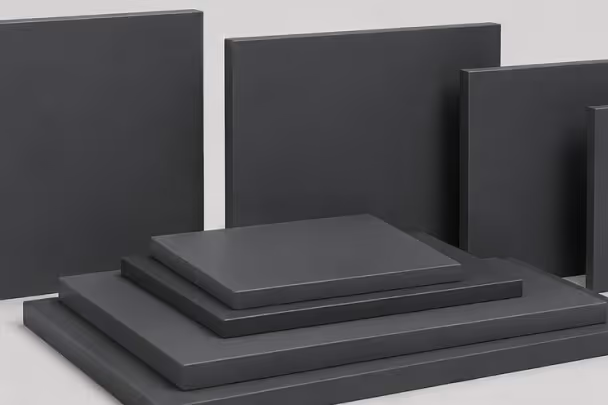
Plates
Bearing-grade PEEK plates are supplied for machined wear pads, guides, and sliding surfaces. Plates available from 3/8" to 4" thickness.
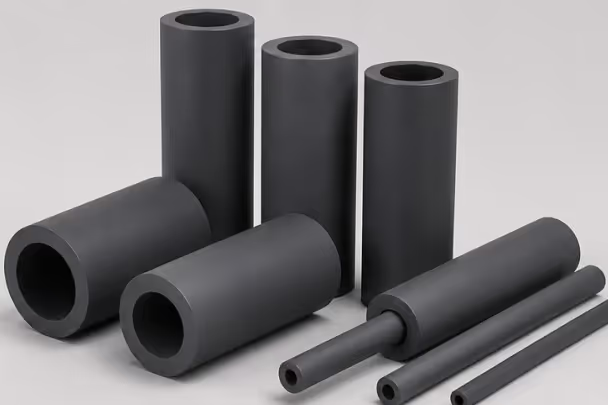
Tubular bars
Tubular bars are available for applications requiring wear resistance with reduced weight.

Trusted by World's Leading Companies

















How PEEK Bearing Grade compares to other PEEK grades
Quick reference guide to help you choose the right material.
| Grade | Best for | Stiffness | Wear | Notes |
|---|---|---|---|---|
| PEEK (unfilled) | General-purpose machined parts | High | Good | Balanced properties and easier machining |
| PEEK GF30 | Structural parts requiring high rigidity | Very high | Good | Improved stiffness and dimensional stability |
| PEEK CF30 | Precision parts with low thermal expansion | Very high | Good | Best choice where heat and movement matter |
| PEEK bearing grade | Sliding and rotating components | High | Very high | Formulated for low friction and improved wear |
Need help determining if PEEK Bearing Grade is the right choice?
Share your part requirements, operating conditions, or motion characteristics and our technical team will guide you on grade selection, stock formats, and supporting documentation.
- Response within one business day
- Reviewed by our technical team
- No obligation or sales pressure
Frequently Asked Questions
PEEK bearing grade is a modified PEEK formulation containing solid lubricants that reduce friction and improve wear performance in moving or sliding applications.
Choose bearing-grade PEEK when your application involves continuous motion, sliding contact, or rotating parts where reduced friction and longer wear life are required.
Yes. Bearing-grade PEEK performs well in dry-running conditions where external lubrication is limited or undesirable.
Unlike CF30 and GF30, which prioritize stiffness and dimensional stability, bearing-grade PEEK is optimized for wear resistance and low friction in dynamic applications.
It can handle moderate to high loads, but for applications where stiffness and minimal deflection are critical, reinforced grades may be more suitable.
Yes. While optimized for wear, it retains the inherent thermal and chemical stability of PEEK, supporting consistent performance under temperature variation.
Electrical properties depend on the specific formulation. For applications where insulation is critical, data sheets should be reviewed.
Moisture absorption remains low, helping components maintain size and performance in humid or wet environments.
Bearing-grade PEEK is supplied as extruded rods, plates, and tubular bars in standard sizes, with custom dimensions available on request.
In many applications, yes. Bearing-grade PEEK is used as a metal replacement where lower weight, corrosion resistance, or reduced lubrication is required.