PEEK CF30 for high rigidity and dimensional stability in precision machined components
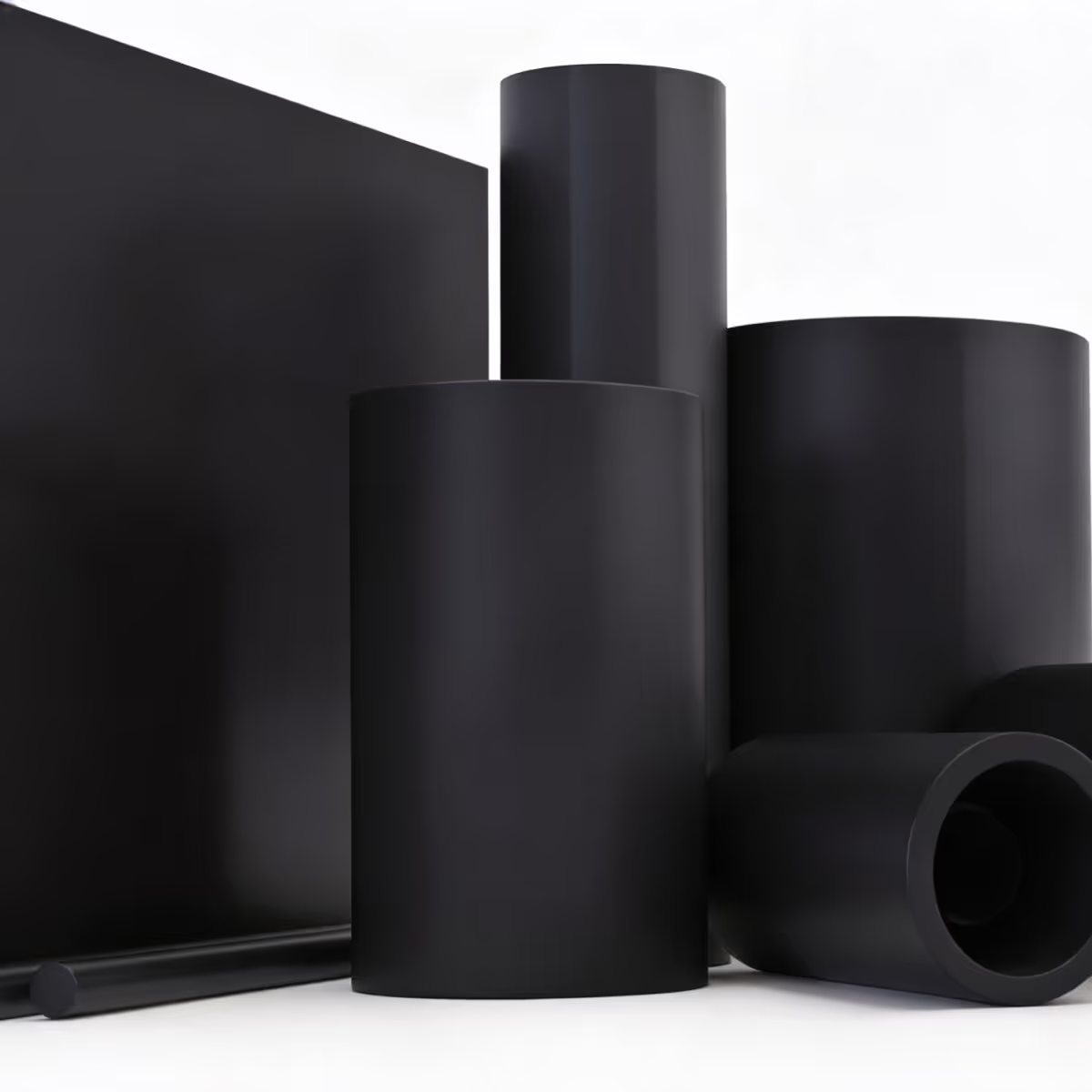
Designed as a high-strength metal replacement, this 30% carbon-fiber-reinforced PEEK provides the ultimate structural rigidity and weight savings needed for the most demanding aerospace and industrial applications. Its extruded shapes, including rods, plates, and tubular bars ensure unparalleled dimensional stability and the lowest possible thermal expansion for precision-machined parts operating under extreme mechanical loads and high-temperature environments.

What PEEK CF30 offers
High-performance characteristics that make PEEK CF30 suitable for precision components requiring maximum rigidity and dimensional stability.

Maximum stiffness among PEEK grades
Carbon fiber reinforcement delivers very high rigidity, making CF30 suitable for parts that must resist deformation under load.

Reduced thermal expansion
A lower coefficient of thermal expansion helps machined components hold tight tolerances across temperature changes.

Excellent dimensional stability under load and heat
CF30 performs reliably in applications where both mechanical stress and elevated temperatures are present.

Improved performance for precision components
High stiffness supports thin-walled designs and parts with tight geometric tolerances.

Strong mechanical strength with low creep
Maintains shape and performance through long-term service in demanding environments.

Common components made from PEEK CF30
Typical machined parts that benefit from high rigidity and low thermal expansion.

Industrial tooling and jigs
Provides reliable performance in high-temperature or high-precision manufacturing processes.

Test fixtures and alignment components
Used in metrology and inspection systems where dimensional stability is critical.

Mechanical supports and brackets
Designed for high-load applications where deflection must be minimized.

Structural aerospace components
Lightweight parts requiring high stiffness and dimensional accuracy.

Semiconductor and electronics fixtures
Suitable for precision tooling, supports, and carriers exposed to heat and cleanroom environments.

Precision housings and frames
Used where tight tolerances must be maintained during operation and thermal cycling.
PEEK CF30 Technical Properties
General performance characteristics of 30 percent carbon fiber reinforced PEEK. Exact values vary by supplier and grade.
| Property | Test | PEEK CF30 | Unit |
|---|---|---|---|
| Tensile Strength | ASTM D638 | 24,000 | PSI |
| Tensile Modulus | ASTM D638 | 1,810 | KSI |
| Elongation @ Break | ASTM D638 | 1.5 | % |
| Flexural Strength | ASTM D790 | 45,000 | PSI |
| Flexural Modulus | ASTM D790 | 1,700 | KSI |
| Compressive Strength | ASTM D695 | 35,000 | PSI |
| Izod Impact (Notched) | ASTM D256 | 1.5 | ft-lb/in |
| Rockwell Hardness | ASTM D785 | M105 | - |
| Property | Test | PEEK CF30 | Unit |
|---|---|---|---|
| Melting Temp | ASTM D3418 | 644 | °F |
| Glass Transition | DSC | 302 | °F |
| HDT (264 psi) | ASTM D648 | 600 | °F |
| CLTE | ASTM E831 | 0.6 | 10⁻⁵/°F |
| Continuous Service | - | 500 | °F |
| Property | Test | PEEK CF30 | Unit |
|---|---|---|---|
| Volume Resistivity | ASTM D257 | 10³ | ohm-cm |
| Property | Test | PEEK CF30 | Unit |
|---|---|---|---|
| Coeff. of Friction | ASTM D3702 | 0.25 | - |
| Limiting PV | - | 15,000 | ft·lb/in²·min |
| Property | Test | PEEK CF30 | Unit |
|---|---|---|---|
| Specific Gravity | ASTM D792 | 1.4 | gm/cm³ |
| Water Absorption (24h) | ASTM D570 | 0.05 | % |

PEEK CF30 rods, plates & tubular bars
Extruded stock shapes are supplied in standard diameters and thicknesses, with custom dimensions available for specific applications.
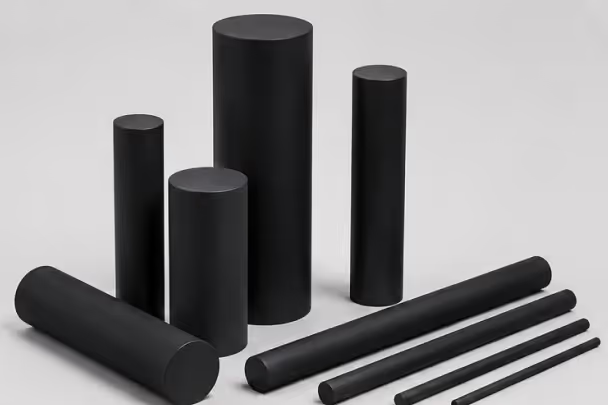
Rods
Extruded PEEK CF30 rods are available for precision structural components, supports, and high-stiffness parts. Rods typically available from 3/8" to 8" diameter.
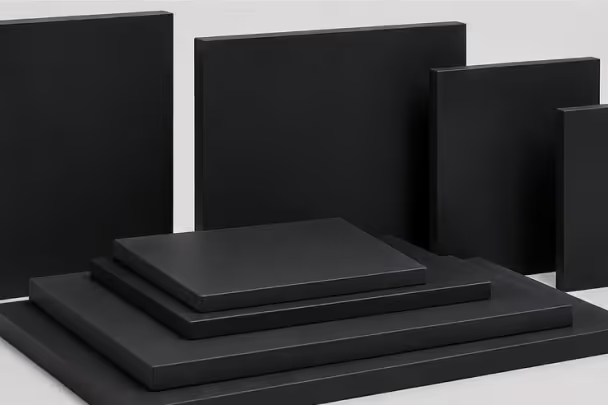
Plates
PEEK CF30 plates are supplied for machined housings, frames, and precision components requiring dimensional stability. Plates available from 3/8" to 4" thickness.
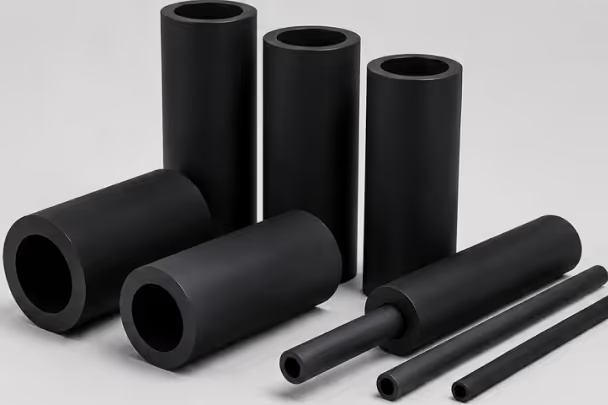
Tubular bars
Tubular bars are available for applications requiring high stiffness with reduced weight.

Trusted by World's Leading Companies

















How PEEK CF30 compares to other PEEK grades
Quick reference guide to help you choose the right material.
| Grade | Best for | Stiffness | Wear | Notes |
|---|---|---|---|---|
| PEEK (unfilled) | General-purpose machined parts | High | Good | Balanced properties and easier machining |
| PEEK GF30 | Structural parts requiring high rigidity | High | Good | Improved stiffness and dimensional stability |
| PEEK CF30 | Precision parts with low thermal expansion | Very High | Good | Best choice where heat and movement matter |
| PEEK bearing grade | Sliding and rotating components | High | Very high | Formulated for low friction and improved wear |
| Grade | Morphology | Stiffness (Modulus) | Operating Temp | Chemical Resistance | Notes |
|---|---|---|---|---|---|
| PEEK CF30 | Semi-Crystalline | Very High | 250°C (480°F) | Exceptional | Best fatigue life and wear resistance; premium cost. |
| Impact-Mod. PPS CF40 | Semi-Crystalline | Highest | 210°C (410°F) | Superior | Maximum rigidity and chemical inertness; extremely stable. |
| Ultem CF15 | Amorphous | High | 170°C (340°F) | Good | Best dimensional precision for complex geometries. |
Need help determining if PEEK CF30 is the right choice?
Share your part requirements, operating conditions, or material challenges and our technical team will guide you on grade selection, stock formats, and supporting documentation.
- Response within one business day
- Reviewed by our technical team
- No obligation or sales pressure
Frequently Asked Questions
PEEK CF30 is a grade of PEEK reinforced with 30 percent carbon fibers. The reinforcement increases stiffness and reduces thermal expansion, making it suitable for precision machined components.
Choose CF30 when dimensional stability and low thermal expansion are more critical than impact resistance. CF30 is preferred for precision and high-temperature applications.
Yes. Carbon fiber reinforcement increases abrasiveness and stiffness, requiring sharper tooling and careful machining parameters.
CF30 is not formulated for low-friction use. Bearing-grade PEEK is a better choice for sliding or rotating components.
Yes. Its low thermal expansion and high rigidity support tight tolerances, especially in temperature-variable environments.
Carbon reinforcement may reduce electrical insulation compared to unfilled PEEK. Electrical properties depend on the specific grade and should be verified against data sheets.
Moisture absorption remains low, similar to other PEEK grades, supporting dimensional stability in humid environments.
PEEK CF30 is supplied as extruded rods, plates, and tubular bars in standard sizes, with custom dimensions available on request.
Yes. CF30 maintains stiffness and dimensional stability at elevated temperatures suitable for demanding industrial applications.
PEEK CF30 has the lowest thermal expansion among standard PEEK grades, making it the preferred choice for precision components exposed to temperature changes.
Choose PEEK CF30 when dimensional stability and low thermal expansion are more important than impact resistance. CF30 is better suited for precision and high-temperature applications.
Yes. The high stiffness and low thermal expansion of CF30 make it ideal for parts that must maintain tight tolerances during operation and thermal cycling.
Carbon reinforcement can reduce electrical insulation compared to unfilled PEEK. Electrical behavior depends on the specific formulation and should be verified against the data sheet for critical applications.
CF30 maintains excellent dimensional stability and low creep under sustained load, particularly in high-temperature environments.
Yes. CF30 is commonly used as a metal replacement where stiffness, dimensional accuracy, and thermal stability are required, with the added benefits of reduced weight and corrosion resistance.
The highest rating is a result of the 40% reinforcement volume and the naturally rigid molecular structure of PPS. While PEEK CF30 is incredibly stiff, Impact-Modified PPS CF40 can reach a flexural modulus exceeding 22,000 MPa, making it the closest thermoplastic equivalent to a cast metal alloy in terms of resisting deflection.
PEEK CF30 is the superior choice for dynamic loads. While PPS CF40 is stiffer, it is more brittle. PEEK's semi-crystalline toughness provides better fatigue resistance, meaning it is less likely to develop micro-cracks under constant cyclic loading or sudden mechanical shock.
Yes, in many structural applications. While it has the lowest stiffness in this "high-tier" group, it is still vastly stronger than standard engineering plastics. It is ideal for lightweight structural frames, aerospace brackets, or electronics housings where dimensional precision is more important than maximum crushing load.
Carbon fiber is highly inert and does not degrade the chemical resistance of the base polymer. Impact-Modified PPS CF40 remains the "chemical champion," resisting almost all known solvents below 200°C. PEEK CF30 is nearly as robust, while Ultem CF15 remains sensitive to specific solvents like ketones or esters.
No. This is a critical distinction. Carbon fiber is conductive. All three of these grades are electrically conductive or static-dissipative (ESD). If your part must act as an electrical insulator, you must switch to a glass-filled (GF) or unfilled grade to avoid short circuits.
Impact-Modified PPS CF40 typically offers the lowest Coefficient of Linear Thermal Expansion (CLTE) due to its high fiber loading. However, PEEK CF30 is very close and is often used when those dimensions must be maintained at temperatures exceeding 200°C. Both materials expand at rates similar to aluminum.
Standard 40% carbon-filled PPS is extremely brittle; it can be difficult to machine without the edges "chipping out" or splintering. The Impact-Modified version adds a toughening agent to the matrix, allowing for cleaner machining of fine threads and ensuring the part doesn't shatter if dropped during assembly.
Yes, it is excellent for this. Carbon fiber is naturally lubricious and helps dissipate heat. Unlike glass-filled PEEK, which is abrasive and grinds away mating metal shafts, PEEK CF30 provides a low-friction surface that is ideal for high-speed bushings and wear rings.
Ultem CF15 often wins for precision. Because it is an amorphous resin, it does not suffer from the internal crystalline stresses that can cause PEEK or PPS to warp or "bow" when a significant amount of material is removed during the milling process.
Absolutely. Carbon fiber is highly abrasive and will dull standard carbide tools in minutes. For production runs of PEEK CF30 or PPS CF40, PCD (Polycrystalline Diamond) tooling is the industry standard to achieve clean fiber cuts and maintain the required tolerances.