PEEK GF30 for high stiffness, high load machined components
Designed as a high-strength metal replacement, this 30% glass-filled PEEK provides the structural rigidity and mechanical toughness needed for demanding applications. Its extruded shapes including rods, plates, and tubes ensure excellent dimensional stability for precision-machined parts operating under heavy loads and extreme temperatures

%20(2).avif)
What PEEK GF30 offers
High-performance characteristics that make PEEK GF30 suitable for demanding structural and load-bearing components.

Higher stiffness and rigidity
Glass fiber reinforcement significantly increases stiffness, making PEEK GF30 well-suited for structural components that must resist bending and deflection.

Improved dimensional stability
Lower thermal expansion and reduced creep enable machined parts to maintain tight tolerances under mechanical load and temperature variation.

Strong mechanical performance under load
Provides higher tensile and flexural strength compared to unfilled PEEK, supporting demanding load-bearing applications.

Better performance for thin-walled and precision parts
The added rigidity supports designs where thinner sections or tighter tolerances are required.

Reliable performance in harsh environments
Maintains stability in environments with heat, mechanical stress, and exposure to fuels, oils, and industrial chemicals.

Common components made from PEEK GF30
Typical machined parts that benefit from the stiffness and strength of glass fiber reinforcement.

Aerospace and industrial fixtures
Suitable for lightweight, high stiffness components used in demanding environments.

Mechanical couplings, clamps, and fittings
High rigidity supports reliable performance in assemblies with mechanical stress.

Electrical and thermal insulation parts
Stable across temperature changes and resistant to moisture uptake.

Precision housings and enclosures
Ideal for parts that must maintain shape and tolerances during machining and operation.

Pump, compressor, and actuator components
Reinforcement helps parts withstand pressure, vibration, and temperature fluctuations.

Structural brackets and supports
Used where high stiffness and minimal deflection are required under load.
PEEK GF30 Technical Properties
| Property | Test | PEEK GF30 | Unit |
|---|---|---|---|
| Tensile Strength | ASTM D638 | 22,000 | PSI |
| Tensile Modulus | ASTM D638 | 1,600 | KSI |
| Elongation @ Break | ASTM D638 | 2.5 | % |
| Flexural Strength | ASTM D790 | 31,000 | PSI |
| Flexural Modulus | ASTM D790 | 1,600 | KSI |
| Compressive Strength | ASTM D695 | 22,000 | PSI |
| Izod Impact (notched) | ASTM D256 | 1.4 | ft-lb/in |
| Hardness Rockwell | ASTM D785 | M99/R126 | — |
| Property | Test | PEEK GF30 | Unit |
|---|---|---|---|
| HDT @ 264 psi | ASTM D648 | 608 | °F |
| Melting Point | — | 662 | °F |
| CLTE | ASTM E831 | 1.6 | in/in/°F × 10⁻⁵ |
| Thermal Conductivity | ASTM C177 | 3.5 | BTU·in/hr·ft²·°F |
| Property | Test | PEEK GF30 | Unit |
|---|---|---|---|
| Dielectric Strength | ASTM D149 | 480 | V/mil |
| Dielectric Constant | ASTM D150 | 3.8 | — |
| Dissipation Factor | ASTM D150 | 0.003 | — |
| Surface Resistivity | ASTM D257 | 10¹⁵ | Ω/sq |
| Volume Resistivity | ASTM D257 | 10¹⁵ | Ω·cm |
| Property | Test | PEEK GF30 | Unit |
|---|---|---|---|
| Coefficient of Friction (Dynamic) | ASTM D3702 | 0.35 | — |
| Wear Rate (K-factor) | ASTM D3702 | 50 | × 10⁻¹⁰ in³·min/ft·lb·hr |
| Property | Test | PEEK GF30 | Unit |
|---|---|---|---|
| Specific Gravity | ASTM D792 | 1.51 | — |
| Water Absorption (24hr) | ASTM D570 | 0.06 | % |
| Flammability | UL94 | V-0 | — |

PEEK GF30 Rods, Plates and Tubular Bars
Extruded stock shapes are supplied in standard diameters and thicknesses, with custom dimensions available for specific applications.
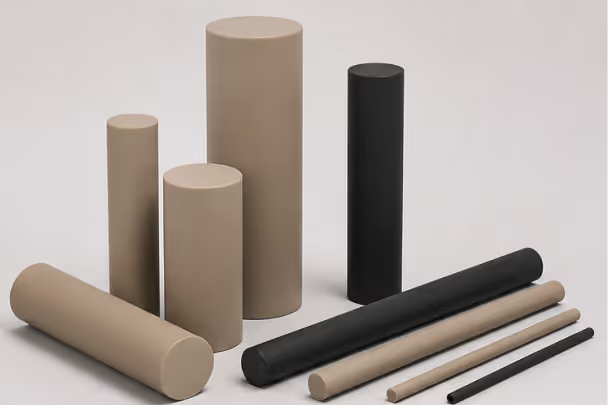
Rods
Extruded PEEK GF30 rods are available in a range of diameters suitable for structural parts, supports, and load-bearing components. Rods are available from 1/2" to 8" diameter.
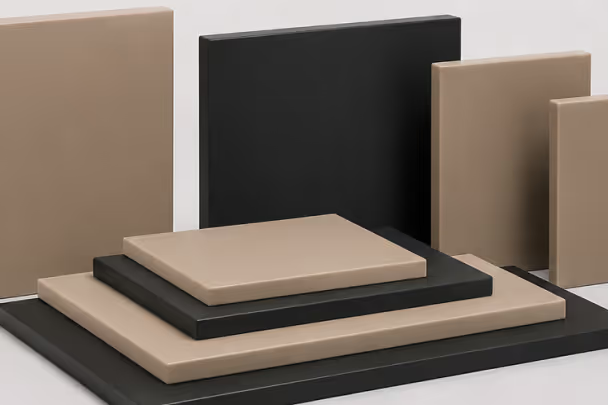
Plates
PEEK GF30 plates are supplied in standard thicknesses for machined brackets, housings, and precision components. Plates available from 3/8" to 4" thickness.
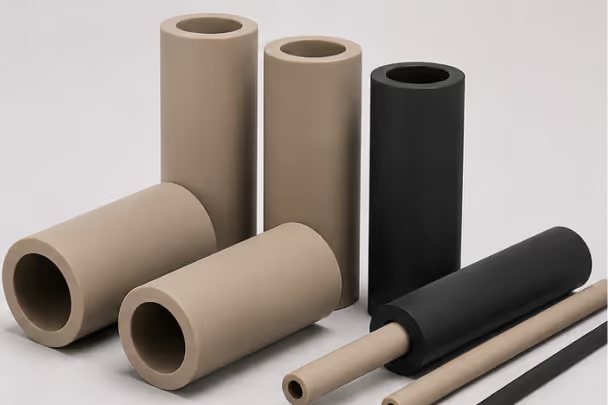
Tubular Bars
Tubular bars are supplied for applications requiring reduced weight while maintaining strength and dimensional stability.

Trusted by World's Leading Companies

















How PEEK GF30 compares to other PEEK grades
Quick reference guide to help you choose the right material.
Need help determining if PEEK GF30 is the right choice?
Share your part requirements, operating conditions, or material challenges and our technical team will guide you on grade selection, stock formats, and supporting documentation.
- Response within one business day
- Reviewed by our technical team
- No obligation or sales pressure
Frequently Asked Questions
PEEK GF30 is a grade of PEEK reinforced with 30 percent glass fibers. The reinforcement increases stiffness, strength, and dimensional stability, making it suitable for structural and load-bearing machined parts.
Choose PEEK GF30 when your part needs higher rigidity, lower thermal expansion, or improved dimensional stability under load or temperature changes. It is preferred for brackets, housings, supports, and components that must resist bending.
GF30 provides excellent stiffness and stability, while CF30 offers even higher rigidity and lower thermal expansion. GF30 is often chosen for structural strength, whereas CF30 is chosen for precision parts exposed to heat or requiring very low deformation.
GF30 is not designed specifically for low-friction or high-wear situations. For sliding components, bearing-grade PEEK or PTFE-filled formulations generally perform better.
Yes. The added stiffness and abrasiveness of the glass fibers require sharper tooling, slower feeds, and careful heat management. Using carbide tools and planning for higher tool wear helps maintain tolerances and surface finish.
Yes. GF30's reduced thermal expansion and improved dimensional stability support tight tolerances, especially when parts are allowed to relax between roughing and finishing passes.
Yes. Although reinforced with glass fibers, GF30 maintains strong electrical insulation properties and performs well in high-temperature or humid environments.
PEEK GF30 has low moisture absorption, similar to unfilled PEEK. This helps machined components maintain shape, size, and electrical performance in humid or wet environments.
PEEK GF30 is supplied as extruded rods and plates in standard diameters and thicknesses. Custom dimensions can be produced on request.
Yes. GF30 maintains performance at elevated temperatures, with stiffness and dimensional stability that exceed unfilled PEEK. Exact operating limits depend on the specific grade.
While PPS GF40 has a higher flexural modulus (it is more rigid), it is notoriously brittle. PEEK GF30 is chosen when you need that high stiffness combined with toughness. If your part is subject to impact, vibration, or "snap-fit" assembly, PPS GF40 will likely shatter, whereas PEEK GF30 will hold.
PEEK GF30 is the gold standard for hydrolysis resistance. It can survive thousands of autoclave cycles or "downhole" steam environments without losing mechanical properties. PPS is also good, but Ultem GF30 (PEI) can begin to lose its strength over long-term continuous exposure to high-pressure steam.
For "as-machined" precision, Ultem GF30 often wins. As an amorphous polymer, it has very low and uniform shrinkage.
Yes, often. PPS is frequently called "the smart man's PEEK" because its chemical resistance is actually superior in some specific cases (it has no known solvents below 200°C). If the operating temperature is below 220°C and there is no high impact, PPS GF40 is the most cost-effective choice.
Ultem (PEI) has one of the highest dielectric strengths of any available thermoplastic. While PEEK is a good insulator, Ultem's electrical properties remain more stable across a wide range of temperatures and frequencies, and it is inherently flame-retardant (V-0) with very low smoke evolution.
PEEK GF30 generally offers the best long-term creep resistance at elevated temperatures. While PPS GF40 is very stiff initially, PEEK's semi-crystalline structure allows it to maintain its "geometric memory" better when pushed to 200°C+.
Actually, it's usually the other way around. However, Concentrated Sulfuric Acid and Nitric Acid will quickly degrade PEEK. On the flip side, Ultem is very sensitive to Ketones (like Acetone) and Methylene Chloride, which can cause it to crack instantly (Environmental Stress Cracking), while PEEK remains unaffected.
All three are "tool killers" because of the glass reinforcement. However, PPS GF40 is the most abrasive due to its higher (40%) glass loading and ceramic-like hardness. You must use PCD (Diamond) or high-grade carbide tooling for all three to maintain a good surface finish.
Yes, all three offer significant weight savings (roughly 80% lighter than steel). PEEK GF30 is the most common metal replacement for structural aerospace or oil-field parts because its strength-to-weight ratio remains stable even at high temperatures where aluminum or other plastics might fail.
PEEK GF30 is the most resilient to thermal cycling. Its balance of high ductility and high-temperature strength allows it to expand and contract without developing the micro-cracks that can occur in more brittle materials like PPS.