PEEK PTFE-20 Stock Shapes
A specialized bearing-grade PEEK supplied as extruded rods and plates. This material combines the extreme thermal and chemical resistance of the PEEK matrix with the superior lubricity of PTFE, designed specifically for machined components subjected to high-speed sliding or oscillating movements.

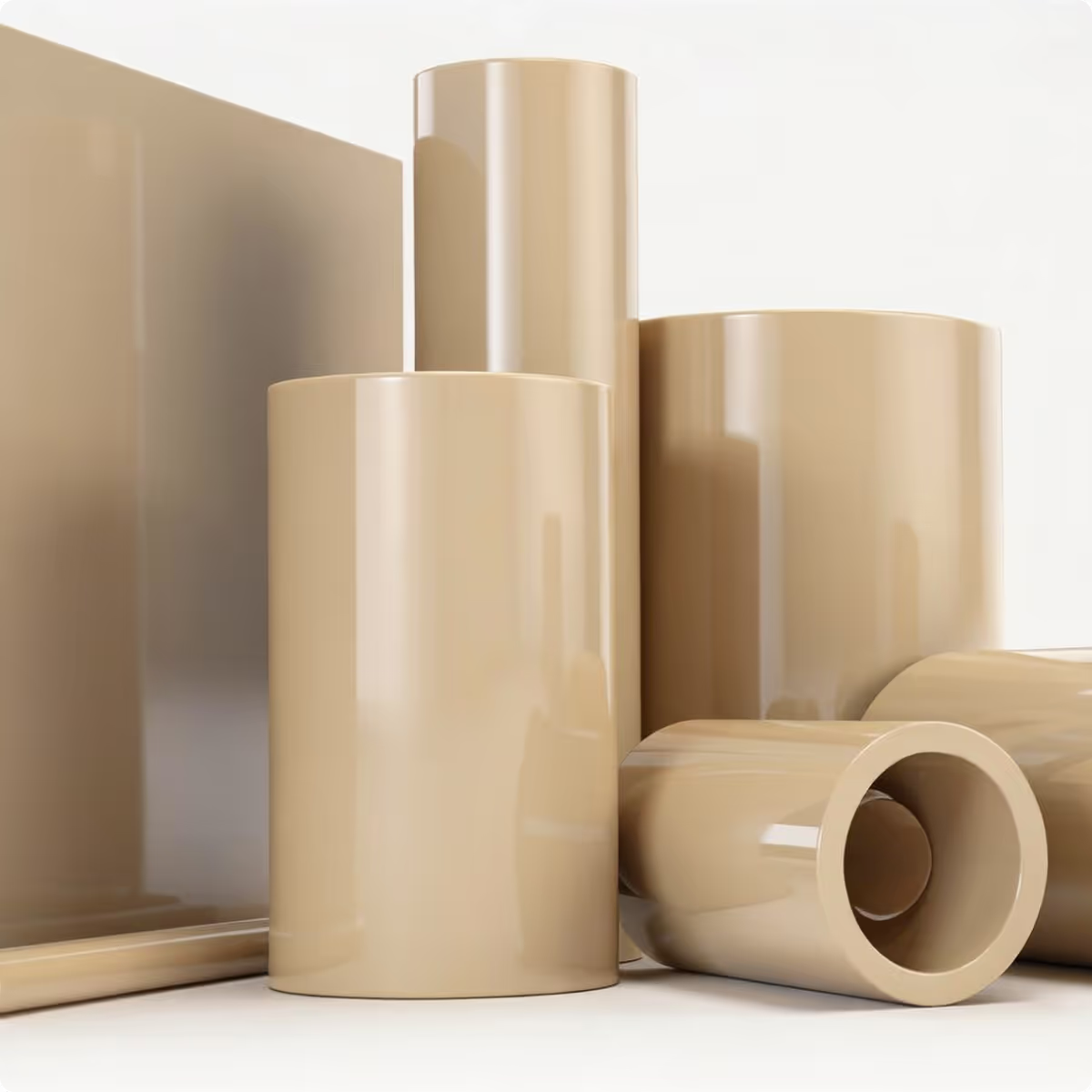
What PEEK-PTFE20 Offers
Performance characteristics that make PEEK-PTFE20 suitable for demanding wear and sliding applications.

Enhanced wear resistance
Internal PTFE lubrication prevents galling and stick-slip, extending the service life of bushings and wear strips well beyond unfilled PEEK.

Excellent dimensional stability
Holds tight tolerances in high-moisture and high-heat conditions, with lower thermal expansion than most commodity plastics.

High continuous service temperature
Keeps its mechanical integrity at temperatures up to 260°C (500°F), suiting aerospace and downhole energy environments.

Superior machinability
The PTFE acts as a chip-breaker during machining, giving a smoother surface finish and easier cutting than glass-filled alternatives.

Non-abrasive to mating parts
Unlike glass- or carbon-filled grades, the soft PTFE filler will not score or scratch the metal shafts and housings it runs against.

Common components made from PEEK-PTFE20
Typical machined parts that benefit from low friction and clean non conductive wear performance.
Oil & Gas / Energy
Backup rings, sucker rod guides, and electrical connector housings for downhole environments with high pressure and corrosive fluids.
Aerospace & Defense
Interior actuator bushings, valve seats in fuel systems, and cable guides requiring weight reduction and chemical inertness.
Food Processing & Packaging
Filling machinery piston seals, conveyor wear strips, and baking equipment components operating at high heat without external oil.
Medical & Analytical Instrumentation
Centrifuge components, surgical power tool bushings, and diagnostic equipment moving parts where lubrication would contaminate sensors.
Semiconductor & Electronics Manufacturing
Wafer handling components, test fixtures, and circuit board carriers that require high dimensional stability and low friction without conducting electricity.
PEEK Bearing Grade Technical Properties
| Property | Test | PEEK PTFE-20 | Unit |
|---|---|---|---|
| Tensile Strength | ASTM D638 | 12,000 | PSI |
| Tensile Modulus | ASTM D638 | 600 | KSI |
| Elongation @ Break | ASTM D638 | 30 | % |
| Flexural Strength | ASTM D790 | 16,000 | PSI |
| Flexural Modulus | ASTM D790 | 600 | KSI |
| Compressive Strength | ASTM D695 | 14,000 | PSI |
| Izod Impact (notched) | ASTM D256 | 0.9 | ft-lb/in |
| Hardness Rockwell | ASTM D785 | M85/R115 | — |
| Property | Test | PEEK PTFE-20 | Unit |
|---|---|---|---|
| HDT @ 264 psi | ASTM D648 | 590 | °F |
| Melting Point | — | 662 | °F |
| CLTE | ASTM E831 | 2.8 | in/in/°F × 10⁻⁵ |
| Thermal Conductivity | ASTM C177 | 2.5 | BTU·in/hr·ft²·°F |
| Property | Test | PEEK PTFE-20 | Unit |
|---|---|---|---|
| Dielectric Strength | ASTM D149 | 480 | V/mil |
| Dielectric Constant | ASTM D150 | 3.3 | — |
| Dissipation Factor | ASTM D150 | 0.002 | — |
| Surface Resistivity | ASTM D257 | 10¹⁵ | Ω/sq |
| Volume Resistivity | ASTM D257 | 10¹⁵ | Ω·cm |
| Property | Test | PEEK PTFE-20 | Unit |
|---|---|---|---|
| Coefficient of Friction (Dynamic) | ASTM D3702 | 0.10 | — |
| Wear Rate (K-factor) | ASTM D3702 | 5 | × 10⁻¹⁰ in³·min/ft·lb·hr |
| Property | Test | PEEK PTFE-20 | Unit |
|---|---|---|---|
| Specific Gravity | ASTM D792 | 1.49 | — |
| Water Absorption (24hr) | ASTM D570 | 0.06 | % |
| Flammability | UL94 | V-0 | — |

PEEK bearing grade rods, plates & tubular bars
Extruded stock shapes are supplied in standard diameters and thicknesses, with custom dimensions available for specific applications.
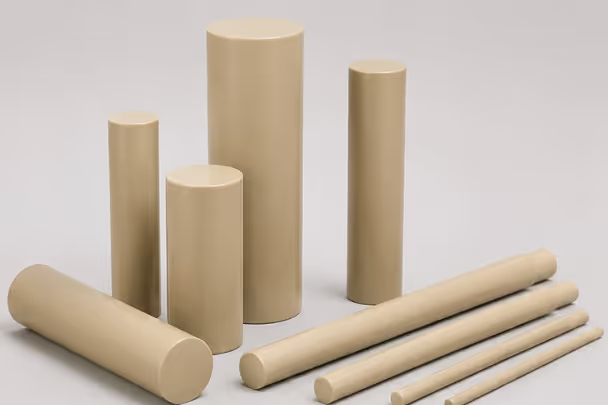
Rods
Extruded PEEK PTFE-20 grade rods are supplied for bushings, bearings, wear rings, and sliding components. Rods typically available from 1/2" to 8" diameter.
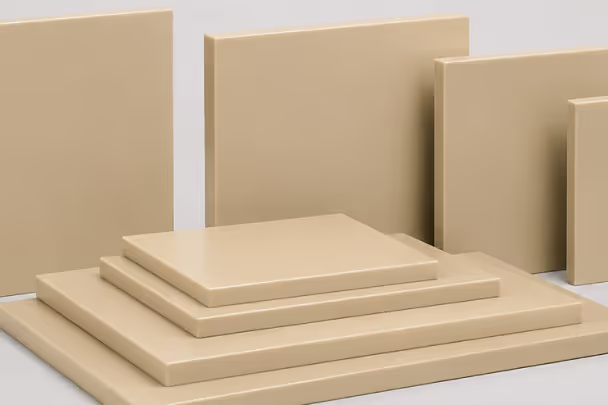
Plates
Bearing-grade PEEK plates are supplied for machined wear pads, guides, and sliding surfaces. Plates available from 3/8" to 4" thickness.
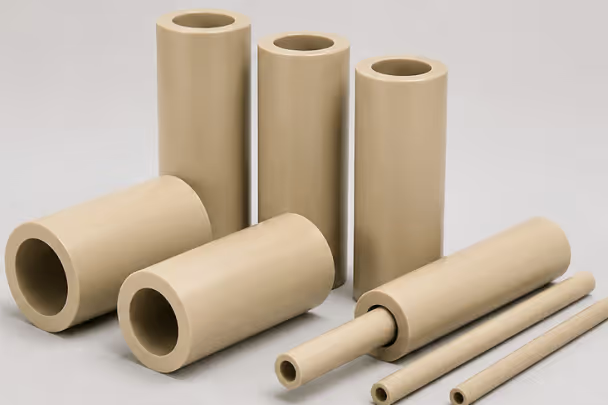
Tubular bars
Tubular bars are available for applications requiring wear resistance with reduced weight.

Trusted by World's Leading Companies

















Grade comparison between PEEK-PTFE20 and PEEK-BG
Quick reference guide to help you choose the right bearing material.
| Feature | PEEK-PTFE20 | PEEK-BG (10/10/10 Grade) |
|---|---|---|
| Composition | 80% PEEK, 20% PTFE | 70% PEEK, 10% CF, 10% Graphite, 10% PTFE |
| Dynamic CoF (Dry) | 0.15 – 0.25 | 0.05 – 0.15 |
| Limiting PV | ~15,000 – 20,000 | ~35,000 – 50,000+ |
| Wear Rate (K-factor) | Moderate (~25% of unfilled PEEK) | Extremely Low (~5% of unfilled PEEK) |
| Tensile Strength | ~11,000 psi (75 MPa) | ~18,000 psi (125 MPa) |
| Flexural Modulus | ~460,000 psi (3.2 GPa) | ~1,000,000+ psi (7.0 GPa) |
| Electrical Prop. | Insulative | Conductive / Static Dissipative |
| Thermal Conductivity | Low (Insulator) | High (Graphite/CF help dissipate heat) |
| Friction & PV | PTFE content improves CoF vs unfilled PEEK (~0.40), but lacks reinforcing fibers for heat dissipation. Lower Limiting PV; surface will soften and "smear" under high speed/load. | Synergistic effect of graphite and PTFE creates very low CoF (<0.10). Carbon fibers provide structural backbone preventing deformation; graphite acts as thermal bridge. |
| Best Use Case | Intermittent motion, medium loads, or environments where carbon/graphite contamination is prohibited (e.g., medical or semiconductor cleanrooms). | High-speed bushings, thrust washers, and wear rings in industrial pumps or aerospace actuators requiring intense, constant friction. |
Need help determining if PEEK bearing grade is the right choice?
Share your part requirements, operating conditions, or motion characteristics and our technical team will guide you on grade selection, stock formats, and supporting documentation.
- Response within one business day
- Reviewed by our technical team
- No obligation or sales pressure
Frequently Asked Questions
Standard bearing grade usually contains 10% Carbon Fiber, 10% Graphite, and 10% PTFE. PEEK-PTFE20 is a "cleaner" alternative that focuses purely on reducing friction without the abrasiveness of carbon or the messiness of graphite.
Many formulations of PEEK-PTFE20 are FDA compliant, making it a favorite for high-heat food processing and packaging machinery.
Yes, compared to unfilled PEEK, there is a slight reduction in tensile strength and a noticeable reduction in stiffness. However, it remains much stronger than pure PTFE.
Yes. It has extremely low outgassing properties, similar to standard PEEK, but with the added benefit of self-lubrication in a vacuum where oils would evaporate.
It is generally supplied in a light brown or tan color, though it can vary slightly between manufacturers.
It is exceptionally stable in steam and hot water (hydrolytic stability), outperforming materials like Ultem or Nylon in those conditions.
Yes. Unlike carbon-filled grades, PEEK-PTFE20 remains an excellent electrical insulator with high dielectric strength.
It performs best against hardened steel or stainless steel shafts with a surface finish of 16 RMS or better.
While it resists creep better than almost any other thermoplastic, the PTFE content makes it slightly more prone to deformation under constant high pressure than glass-filled PEEK.
Yes. Due to the high PTFE content and the chemical inertness of PEEK, specialized surface etching or plasma treatment is usually required for successful bonding.