Ultem 2100 for precision machined components requiring improved stiffness
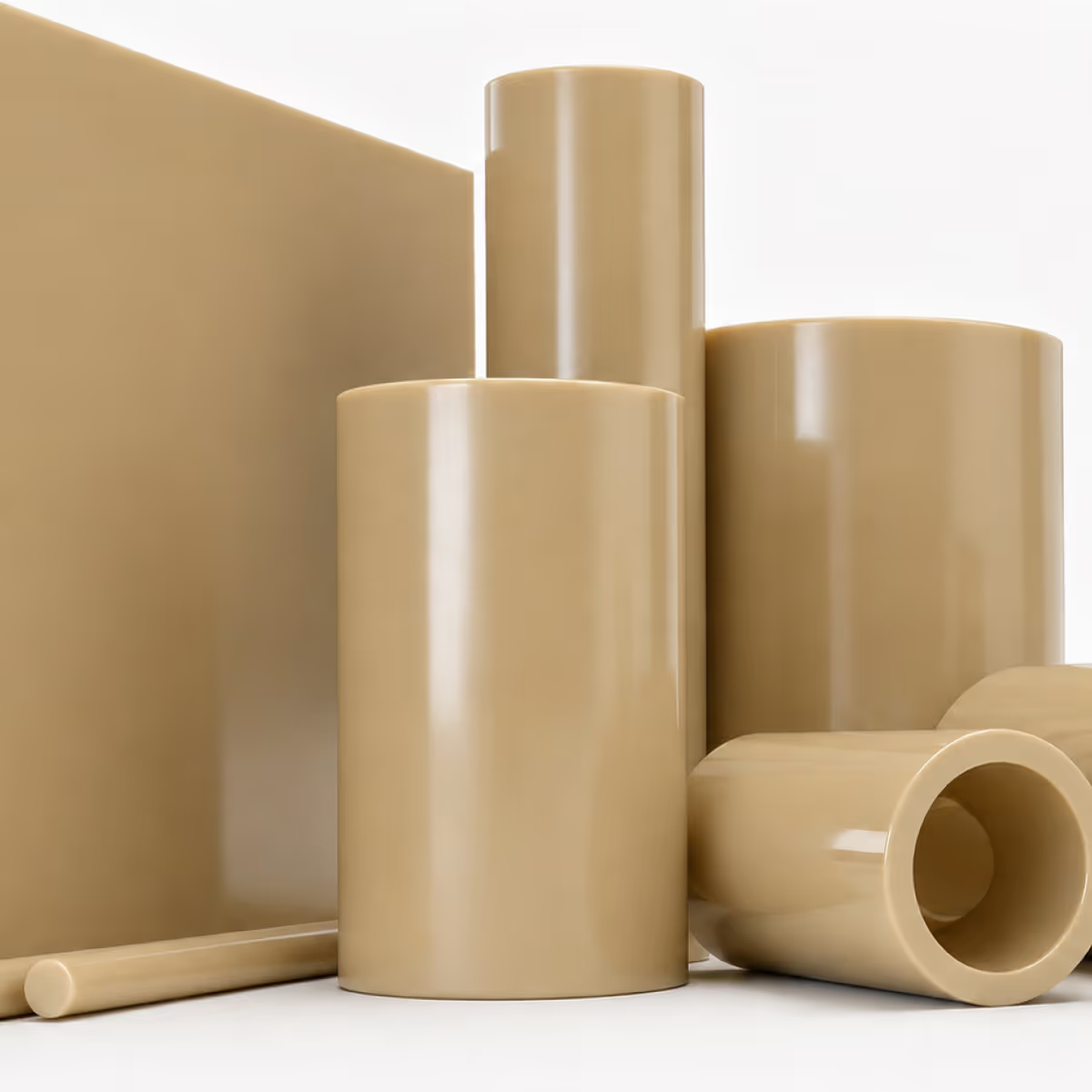
Ultem™ 2100 is a 10% glass fiber reinforced polyetherimide (PEI) supplied in extruded rods and plates. It is specifically designed for machined components that require greater rigidity and dimensional stability than unfilled Ultem™ 1000, while still maintaining the material's signature thermal resistance and high dielectric strength.

What Ultem 2100 offers
Performance characteristics that make Ultem 2100 the ideal middle ground between unfilled and heavily reinforced grades.

Increased stiffness over unfilled Ultem™
The 10% glass fiber adds real rigidity over the 1000 series, reducing deflection and bowing in parts under mechanical load.

Maintains high-temperature performance
Keeps Ultem’s thermal profile with continuous use up to 170°C (340°F), so it holds up in near-engine and under-hood applications.

Good electrical insulation properties
Engineered to retain strong dielectric performance despite the glass reinforcement, suiting electrical housings and high-frequency components.

Improved dimensional stability under load
The glass fibers reduce creep, helping precision-machined parts hold critical tolerances and fitment over their service life.

Balanced performance for structural parts
More structural than unfilled Ultem 1000, but easier to machine and less brittle than 30% glass-filled Ultem 2300.

Common components made from Ultem GF10
Typical machined parts that benefit from added stiffness while maintaining electrical and thermal performance.

Structural brackets
Suitable for lightweight aerospace or industrial brackets that require more rigidity than standard unfilled plastics but do not need the extreme stiffness of 30% glass-filled grades.

Semiconductor test sockets
Offers the stability required for fine-pitch testing where unfilled materials might flex or creep.

Electronic spacers and stand-offs
Provides rigid support and electrical isolation in densely packed avionics or server rack assemblies.

Precision connectors
Used for multi-pin electrical connectors where pins must remain perfectly aligned during high-temperature soldering or operation.
Ultem 2100 Technical Properties
| Property | Test | ULTEM 2100 | Unit |
|---|---|---|---|
| Tensile Strength | ASTM D638 | 18,000 | PSI |
| Tensile Modulus | ASTM D638 | 580 | KSI |
| Elongation @ Break | ASTM D638 | 4 | % |
| Flexural Strength | ASTM D790 | 26,000 | PSI |
| Flexural Modulus | ASTM D790 | 620 | KSI |
| Compressive Strength | ASTM D695 | 20,000 | PSI |
| Izod Impact (notched) | ASTM D256 | 1.1 | ft-lb/in |
| Hardness Rockwell | ASTM D785 | M114 | — |
| Property | Test | ULTEM 2100 | Unit |
|---|---|---|---|
| HDT @ 264 psi | ASTM D648 | 400 | °F |
| Melting Point | — | Amorphous | — |
| CLTE | ASTM E831 | 1.9 | in/in/°F × 10⁻⁵ |
| Thermal Conductivity | ASTM C177 | 2.0 | BTU·in/hr·ft²·°F |
| Property | Test | ULTEM 2100 | Unit |
|---|---|---|---|
| Dielectric Strength | ASTM D149 | 710 | V/mil |
| Dielectric Constant | ASTM D150 | 3.5 | — |
| Dissipation Factor | ASTM D150 | 0.0015 | — |
| Surface Resistivity | ASTM D257 | 10¹⁶ | Ω/sq |
| Volume Resistivity | ASTM D257 | 10¹⁶ | Ω·cm |
| Property | Test | ULTEM 2100 | Unit |
|---|---|---|---|
| Coefficient of Friction (Dynamic) | ASTM D3702 | 0.38 | — |
| Wear Rate (K-factor) | ASTM D3702 | 185 | × 10⁻¹⁰ in³·min/ft·lb·hr |
| Property | Test | ULTEM 2100 | Unit |
|---|---|---|---|
| Specific Gravity | ASTM D792 | 1.34 | — |
| Water Absorption (24hr) | ASTM D570 | 0.20 | % |
| Flammability | UL94 | V-0 | — |

Ultem 2100 rods, plates & tubular bars
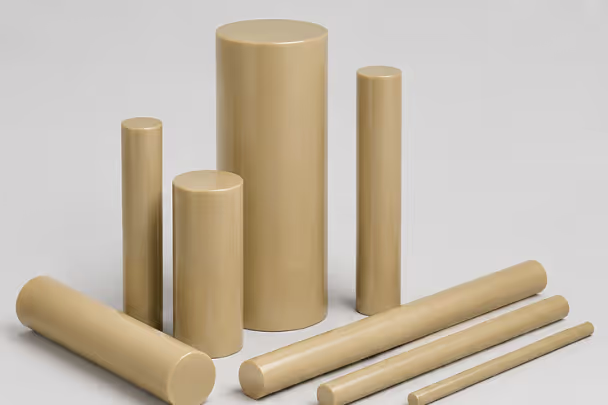
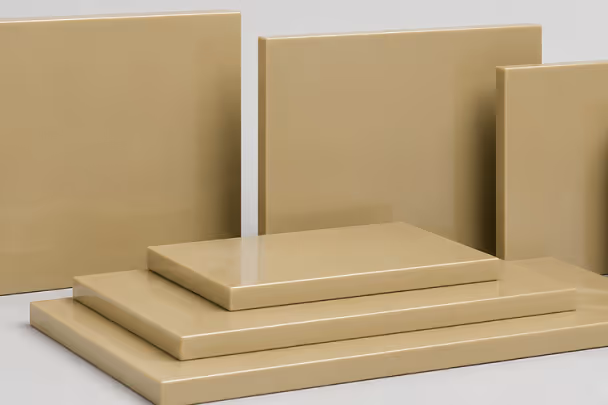
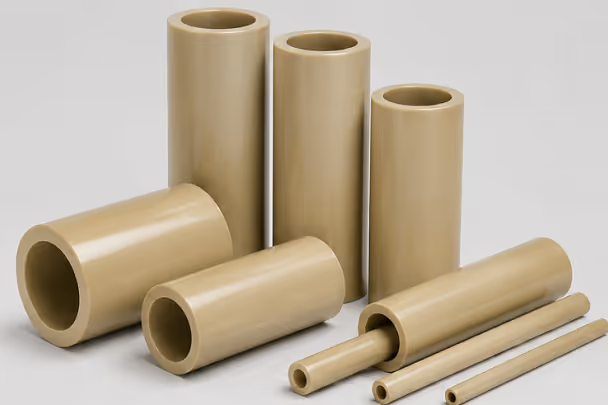
Extruded stock shapes are supplied in standard diameters and thicknesses, with custom dimensions available for specific applications.
Rods
Extruded Ultem 2100 rods are supplied for structural and electrically insulating components exposed to heat. Rods typically available from 1/2" to 8" diameter.
Plates
Ultem 2100 plates are supplied for machined panels, brackets, and housings. Plates available from 3/8" to 4" thickness.
Tubular bars
Tubular bars are available for applications requiring improved stiffness with reduced weight.

Trusted by World's Leading Companies

















How Ultem 2100 compares to glass-filled Ultem grades
Quick reference guide to help you choose the right Ultem material for your application.
| Grade | Reinforcement | Stiffness | Key Advantage | Primary Application |
|---|---|---|---|---|
| Ultem 1000 | Unfilled | Low | Insulation & Clarity: Highest dielectric strength and translucency. | Electrical insulators, medical manifolds. |
| Ultem 2100 | 10% Glass | Medium | Precision: Improved stability with high machinability. | Precision connectors and electronic spacers. |
| Ultem 2200 | 20% Glass | Moderate | Structural Balance: High strength with lower creep. | Internal shafts, pins, and structural mounts. |
| Ultem 2300 | 30% Glass | High | Rigidity: Maximum stiffness for load-bearing parts. | Aerospace housings, metal-replacement brackets. |
| Ultem CF15 | 15% Carbon | Very High | Extreme Strength: Highest modulus and static dissipative. | ESD-safe semiconductor nests, high-modulus aero. |
| Ultem CRS5201 | 20% GF Copolymer | Moderate | Chemical Shield: Resists aggressive acids and bases. | Oil & Gas downhole tools, chemical valves. |
| Ultem CRS5301 | 30% GF Copolymer | High | Ultimate Chemical Strength: Max resistance + stiffness. | Harsh industrial pumps, aggressive fluid handling. |
Need help determining if Ultem 2100 is the right choice?
Share your load conditions, operating temperatures, or electrical requirements and our technical team will guide you on grade selection, stock formats, and supporting documentation.
- Response within one business day
- Reviewed by our technical team
- No obligation or sales pressure
Frequently Asked Questions
Ultem™ 2100 is a 10% glass fiber reinforced polyetherimide (PEI). It serves as the bridge between the ductile, unfilled Ultem™ 1000 and the highly rigid, 30% glass-filled Ultem™ 2300. It is engineered to provide a boost in stiffness and dimensional stability without sacrificing the ease of machining.
You should move to GF10 when your part requires tighter tolerances or needs to resist creep (deformation under constant load). While the unfilled grade is tougher, GF10 is less likely to "move" or expand during thermal cycling, making it superior for precision-aligned components like multi-pin connectors.
No. Unlike carbon fiber reinforcement, the glass fibers in Ultem™ 2100 are non-conductive. It remains an excellent electrical insulator. While the dielectric strength is slightly lower than the unfilled grade (700 V/mil vs. 830 V/mil), it is still far superior to most other engineering plastics.
Ultem™ 2100 is considered the "sweet spot" for machinists. It is rigid enough to allow for very clean cuts and high-speed drilling without the gumminess sometimes found in unfilled plastics. However, because it contains glass, carbide tooling is recommended to prevent the accelerated edge wear associated with standard high-speed steel (HSS) tools.
Yes. It shares the same high thermal DNA as the rest of the family. It maintains a continuous-use temperature of 170°C (340°F) and has a high heat deflection temperature, making it reliable for under-the-hood automotive or aerospace avionics applications.
No. The addition of glass fibers makes the material opaque. While it retains a tan/gold hue, you can no longer see through it. If your application requires visual inspection of internal fluid levels or cracks, you must stay with the unfilled Ultem™ 1000.
Like all Ultem™ grades, 2100 has very low moisture absorption. This is critical for electronic applications where moisture can cause "swelling" and lead to electrical shorts or mechanical binding in tight-tolerance assemblies.
Yes. It is highly resistant to repeated autoclave sterilization cycles. The 10% glass reinforcement actually helps the instrument maintain its "feel" and rigidity during use, which is often preferred for surgical handles or structural medical brackets.
High-density connectors where pins must stay perfectly straight. Terminal blocks requiring heat resistance and rigidity. Aerospace spacers as lightweight structural components. Semiconductor nests where moderate stiffness is required for IC testing.
Ultem™ 2100 is typically priced similarly to the other glass-filled grades (2200 and 2300). It is more expensive than standard unfilled Ultem™ 1000 but offers a significant performance-to-cost advantage when compared to exotic materials like PEEK GF30.