Ultem 2300 (GF30): High-Stiffness, Load-Bearing Structural Components
Ultem 2300 is a 30% glass-fiber-reinforced Polyetherimide. Supplied primarily as extruded rods and plates, this material is engineered specifically for machined components that must withstand significant mechanical loads without deforming. By adding glass fibers to the base PEI resin, the material achieves a significant leap in tensile modulus and dimensional stability compared to unfilled Ultem 1000.

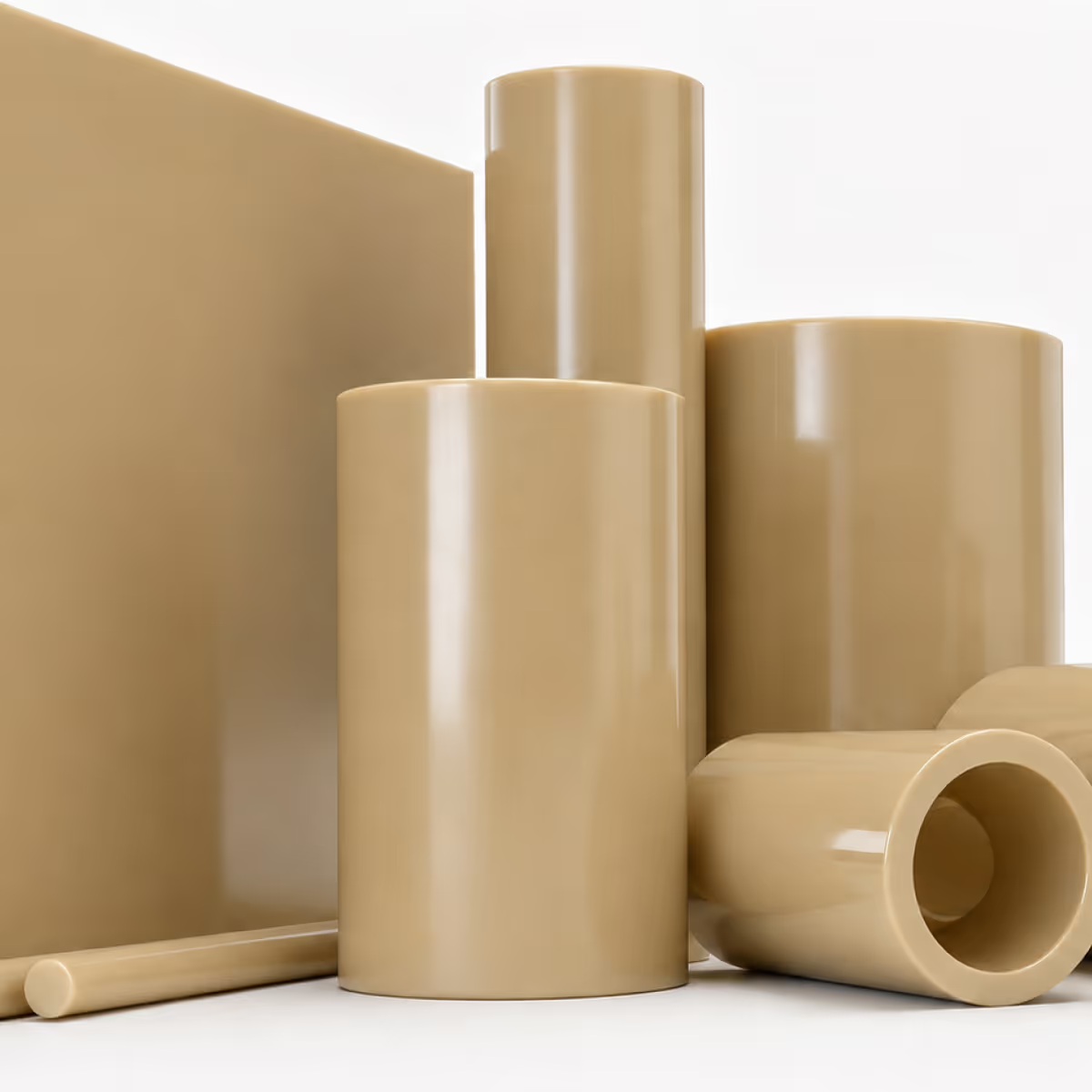
What Ultem GF30 offers
Performance characteristics that make Ultem GF30 the preferred choice for demanding load-bearing structural applications.

Highest stiffness among Ultem grades
High glass fiber content delivers maximum rigidity, making GF30 suitable for demanding load-bearing applications.

Minimal creep under sustained load
Excellent resistance to long-term deformation helps parts hold their geometry in structurally critical applications.

Reliable performance at elevated temperatures
Maintains mechanical integrity and dimensional stability in continuous high-temperature environments.

Excellent dimensional stability
Reduced deflection and lower thermal expansion support tight tolerances in structural components.

Built for heavily loaded structural parts
Best suited to applications where mechanical performance matters more than ease of machining or insulation.

Common components made from Ultem GF30
Typical machined parts that benefit from maximum stiffness and structural stability.

Transportation and rail structural components
Used where flame retardancy and maximum stiffness are required.

Semiconductor equipment structures
Provides stability in precision systems exposed to elevated temperatures.

Industrial fixtures and supports
Used in tooling and equipment requiring high rigidity and dimensional accuracy.

Aerospace interior structural parts
Selected for components requiring flame resistance with high mechanical strength.

Frames and structural housings
Suitable for rigid enclosures exposed to mechanical stress and heat.

Load-bearing structural brackets and supports
Used in assemblies where minimal deflection under load is critical.
Ultem 2300 Technical Properties
| Property | Test | ULTEM 2300 | Unit |
|---|---|---|---|
| Tensile Strength | ASTM D638 | 24,500 | PSI |
| Tensile Modulus | ASTM D638 | 1,030 | KSI |
| Elongation @ Break | ASTM D638 | 2 | % |
| Flexural Strength | ASTM D790 | 36,000 | PSI |
| Flexural Modulus | ASTM D790 | 1,100 | KSI |
| Compressive Strength | ASTM D695 | 27,000 | PSI |
| Izod Impact (notched) | ASTM D256 | 1.6 | ft-lb/in |
| Hardness Rockwell | ASTM D785 | M118 | — |
| Property | Test | ULTEM 2300 | Unit |
|---|---|---|---|
| HDT @ 264 psi | ASTM D648 | 420 | °F |
| Melting Point | — | Amorphous | — |
| CLTE | ASTM E831 | 1.2 | in/in/°F × 10⁻⁵ |
| Thermal Conductivity | ASTM C177 | 2.7 | BTU·in/hr·ft²·°F |
| Property | Test | ULTEM 2300 | Unit |
|---|---|---|---|
| Dielectric Strength | ASTM D149 | 650 | V/mil |
| Dielectric Constant | ASTM D150 | 3.9 | — |
| Dissipation Factor | ASTM D150 | 0.0018 | — |
| Surface Resistivity | ASTM D257 | 10¹⁶ | Ω/sq |
| Volume Resistivity | ASTM D257 | 10¹⁶ | Ω·cm |
| Property | Test | ULTEM 2300 | Unit |
|---|---|---|---|
| Coefficient of Friction (Dynamic) | ASTM D3702 | 0.42 | — |
| Wear Rate (K-factor) | ASTM D3702 | 140 | × 10⁻¹⁰ in³·min/ft·lb·hr |
| Property | Test | ULTEM 2300 | Unit |
|---|---|---|---|
| Specific Gravity | ASTM D792 | 1.51 | — |
| Water Absorption (24hr) | ASTM D570 | 0.15 | % |
| Flammability | UL94 | V-0 | — |

Ultem 2300 rods, plates & tubular bars
Extruded stock shapes are supplied in standard diameters and thicknesses, with custom dimensions available for specific applications.
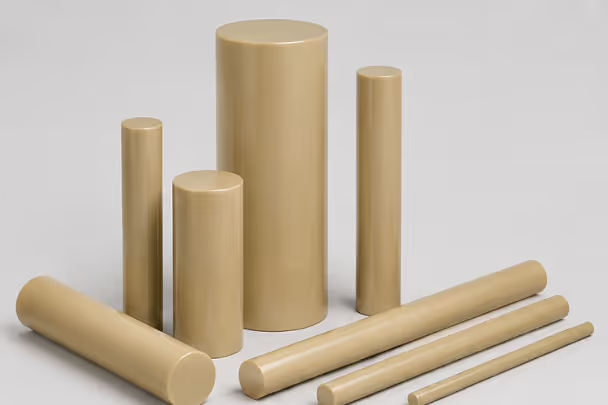
Rods
Extruded Ultem GF30 rods are supplied for high-load structural and support components. Rods typically available from 3/8" to 8" diameter.
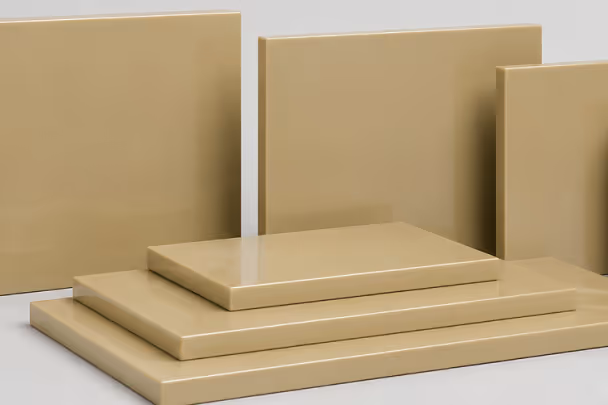
Plates
Ultem GF30 plates are supplied for machined frames, supports, and load-bearing panels. Plates available from 3/8" to 4" thickness.
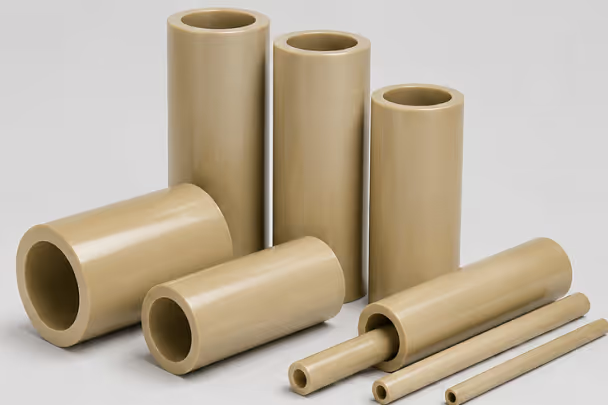
Tubular bars
Tubular bars are available for applications requiring maximum stiffness with reduced weight.

Trusted by World's Leading Companies

















How Ultem GF30 compares to other Ultem grades
Quick reference guide to help you choose the right Ultem material for your application.
| Grade | Reinforcement | Stiffness | Key Advantage | Primary Application |
|---|---|---|---|---|
| Ultem 1000 | Unfilled | Low | Insulation & Clarity: Highest dielectric strength and translucency. | Electrical insulators, medical manifolds. |
| Ultem 2100 | 10% Glass | Medium | Precision: Improved stability with high machinability. | Precision connectors and electronic spacers. |
| Ultem 2200 | 20% Glass | Moderate | Structural Balance: High strength with lower creep. | Internal shafts, pins, and structural mounts. |
| Ultem 2300 | 30% Glass | High | Rigidity: Maximum stiffness for load-bearing parts. | Aerospace housings, metal-replacement brackets. |
| Ultem CF15 | 15% Carbon | Very High | Extreme Strength: Highest modulus and static dissipative. | ESD-safe semiconductor nests, high-modulus aero. |
| Ultem CRS5201 | 20% GF Copolymer | Moderate | Chemical Shield: Resists aggressive acids and bases. | Oil & Gas downhole tools, chemical valves. |
| Ultem CRS5301 | 30% GF Copolymer | High | Ultimate Chemical Strength: Max resistance + stiffness. | Harsh industrial pumps, aggressive fluid handling. |
Need help determining if Ultem 2300 is the right choice?
Share your load conditions, operating temperatures, or structural requirements and our technical team will guide you on grade selection, stock formats, and supporting documentation.
- Response within one business day
- Reviewed by our technical team
- No obligation or sales pressure
Frequently Asked Questions
It indicates that the base Polyetherimide (PEI) resin is reinforced with 30% glass fiber, significantly increasing its mechanical strength compared to unfilled grades.
Glass fibers increase the density. Ultem 2300 has a specific gravity of approximately 1.51, compared to 1.27 for unfilled Ultem 1000.
Yes. A major advantage of 2300 is that its Coefficient of Linear Thermal Expansion (CLTE) is very similar to 6061-T6 aluminum, preventing stress during temperature cycling in metal-to-plastic assemblies.
Absolutely. It maintains high dielectric strength and is frequently used for high-voltage connectors and terminal blocks.
Yes. The glass fibers are abrasive. You must use carbide or diamond-tipped (PCD) tools and slower cutting speeds to prevent premature tool wear.
It has very low moisture absorption (approx. 0.16% over 24 hours), which contributes to its exceptional dimensional stability in humid environments.
Yes, it is inherently flame retardant and typically carries a UL94 V-0 rating without the need for chemical additives.
It is rated for long-term service up to 170°C (340°F), though its glass transition temperature (Tg) is 217°C.
Standard stock shapes are typically Tan (Opaque) or Black. Unlike Ultem 1000, it is not transparent due to the glass fibers.
It is the go-to for structural brackets, fasteners, and interior components that must meet strict FAA smoke and toxicity requirements.