Introduction
Machined components made from high-performance polymers such as PEEK and PPS are widely used in aerospace, semiconductor, energy, medical, industrial, and chemical processing applications.
While engineers often focus on material selection, the manufacturing method used to produce the stock shape can have a significant impact on cost, dimensional stability, machinability, and long-term performance.
Two primary methods are used to manufacture stock shapes for machining:
- Compression Molding
- Extrusion
Both processes can produce rods, plates, and billets suitable for machining. However, they differ substantially in production efficiency, available sizes, consistency, residual stress, and economics.
Understanding these differences helps engineers select the most appropriate material for their application.
Compression Molded Stock Shapes
Compression molding produces stock shapes by consolidating polymer powder or pellets under heat and pressure inside a mold.
The material is heated, compressed, cooled, and removed as a billet, block, or plate.
Advantages
Large Shape Capability
Compression molding is particularly well suited for:
- Very thick plates
- Large billets
- Oversized blocks
- Specialty geometries
When dimensions exceed practical extrusion limits, compression molding may be the only viable manufacturing method.
Flexible Production Quantities
Compression molding can economically produce specialized shapes without requiring continuous production.
Limitations
Lower Production Rates
Compression molding is a batch process involving:
- Loading
- Heating
- Consolidation
- Cooling
- Demolding
As a result, production throughput is significantly lower than extrusion.
Higher Manufacturing Costs
The batch nature of compression molding increases:
- Labor requirements
- Energy consumption
- Manufacturing cost per pound
particularly for larger volumes.
Extruded Stock Shapes
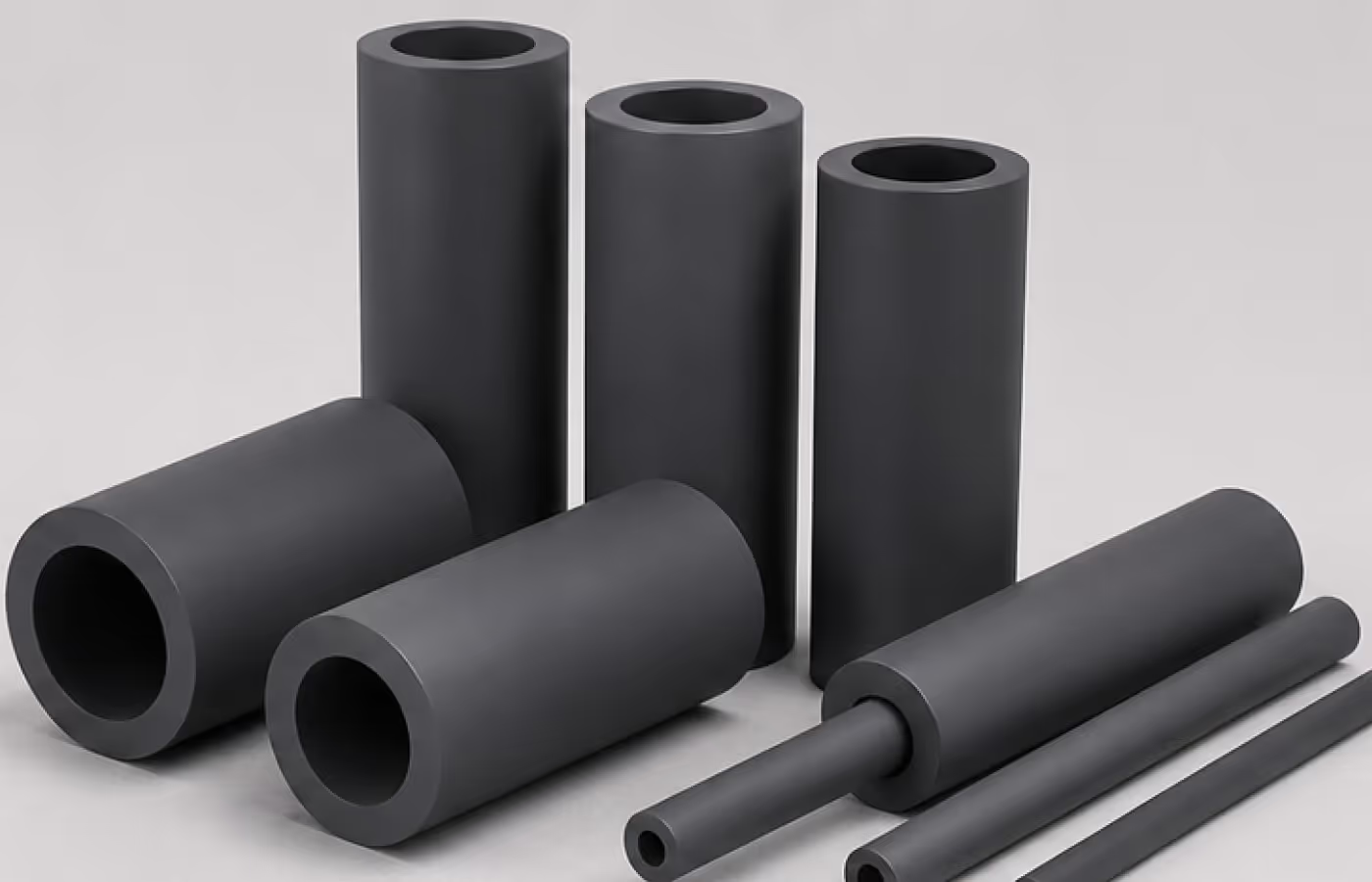
Extrusion produces continuous rods, plates, and tubular bars by forcing molten polymer through a precision die.
The material is continuously shaped, cooled, and subsequently annealed.
Advantages
High Production Efficiency
Extrusion is a continuous manufacturing process capable of producing large quantities efficiently.
Benefits include:
- Lower manufacturing cost
- Higher throughput
- Better material utilization
- Improved supply availability
Consistent Dimensions
Extrusion provides:
- Uniform cross-sections
- Tight dimensional control
- Excellent repeatability
Broad Product Availability
Extrusion is particularly effective for:
- Rods
- Plates
- Tubular bars
which represent the majority of stock shapes used by machine shops.
Limitations
Size Constraints
Very large solid sections become increasingly difficult to cool and process uniformly.
For extremely large billets and thick blocks, compression molding may remain the preferred manufacturing method.
Residual Stress and Dimensional Stability
One of the most misunderstood aspects of stock shape manufacturing is residual stress.
Residual stress refers to internal stress locked into the material during processing.
Excessive residual stress can lead to:
- Part movement during machining
- Warpage
- Reduced dimensional stability
- Premature failure
Compression Molded Shapes
Compression molding generally introduces relatively low flow-induced stresses because material is consolidated rather than forced through a die.
However, thick molded billets can develop:
- Thermal gradients
- Crystallinity variations
- Density variations
particularly in large cross-sections.
Extruded Shapes
Historically, poorly processed extruded shapes were sometimes associated with elevated residual stress.
Modern extrusion combined with proper annealing can produce:
- Very low residual stress
- Uniform crystallinity
- Excellent dimensional stability
- Consistent machining behavior
Today, residual stress is often more dependent on processing quality than on whether the shape was compression molded or extruded.
Mechanical Properties
A common assumption is that compression molded stock shapes automatically provide superior mechanical properties.
In practice, this is often not the case.
For PEEK and PPS, properly processed and annealed extruded stock shapes frequently exhibit equivalent or superior consistency and performance.
Tensile Strength
Both processes can produce excellent tensile properties.
However, extrusion often provides:
- Better consolidation
- More consistent density
- Improved property uniformity
throughout the shape.
Modulus and Stiffness
Stiffness is primarily governed by:
- Polymer chemistry
- Reinforcement level
- Crystallinity
and is generally similar between the two processes when properly manufactured.
Fatigue Resistance
Fatigue performance is highly dependent on:
- Internal defects
- Voids
- Property uniformity
High-quality extruded shapes often perform exceptionally well because of their consistent internal structure.
Impact Resistance
Impact performance is generally comparable when both materials are processed correctly.
Voids or non-uniform consolidation can negatively affect compression molded materials.
Machining Performance
Machine shops frequently report advantages with properly annealed extruded stock shapes:
- More predictable machining
- Better dimensional stability
- Reduced part movement after machining
- Improved repeatability
For precision machined components, these advantages can significantly reduce manufacturing costs.
PEEK: Compression Molded vs. Extruded
PEEK is available in both compression molded and extruded stock forms.
Compression Molded PEEK
Typically selected for:
- Very large billets
- Thick sections
- Specialized shapes
- Low-volume production
Extruded PEEK
Typically selected for:
- Rods
- Plates
- Tubular bars
- High-volume stock shape production
For most machined PEEK components, extruded stock shapes offer excellent performance, consistency, and economics.
PPS: Compression Molded vs. Extruded
Historically, PPS stock shapes were frequently compression molded because PPS is more challenging to process than conventional engineering plastics.
Advances in extrusion technology have significantly changed this landscape.
Modern extrusion processes can now produce:
- Large-diameter rods
- Thick plates
- Tubular bars
- Reinforced PPS grades
with highly consistent properties.
For most PPS machining applications, extrusion provides superior economics while maintaining excellent mechanical performance.
Production Economics
The largest difference between the two processes is often economics.
Compression Molding
Characteristics:
- Batch process
- Long cycle times
- Higher labor content
- Lower throughput
Best suited for:
- Large billets
- Thick blocks
- Specialty geometries
- Lower production quantities
Extrusion
Characteristics:
- Continuous process
- High throughput
- Lower labor content
- Better material utilization
Best suited for:
- Rods
- Plates
- Tubular bars
- Higher production volumes
Typical Cost Comparison
Size Matters
Part size often determines the preferred manufacturing process.
Small and Medium Stock Shapes
For:
- Rods
- Plates
- Tubular bars
extrusion generally offers the best combination of:
- Cost
- Consistency
- Availability
- Performance
Very Large Shapes
When applications require:
- Massive billets
- Extremely thick plates
- Large solid blocks
compression molding may become the preferred or only practical manufacturing method.
In many cases, compression molding's primary advantage is not superior performance—it is the ability to produce very large sections.
The Real Engineering Question
Engineers often ask:
"Which process produces the better material?"
A more useful question is:
"Which process produces the required performance at the lowest total cost?"
For most machined PEEK and PPS components, extruded stock shapes provide the best balance of:
- Mechanical performance
- Dimensional stability
- Property consistency
- Availability
- Cost
Compression molding remains valuable for applications involving exceptionally large shapes or specialized geometries that cannot be produced economically through extrusion.
Conclusion
Both compression molding and extrusion play important roles in the manufacture of high-performance polymer stock shapes.
Compression molding excels when producing very large billets, thick sections, and specialty geometries.
Extrusion excels in producing rods, plates, and tubular bars with outstanding dimensional consistency, uniform mechanical properties, low residual stress, and superior manufacturing economics.
For most machined PEEK and PPS components, the choice is not driven by mechanical performance alone. It is driven by a combination of size, geometry, production volume, availability, and total cost.
In many applications, properly manufactured and annealed extruded stock shapes provide the optimal balance of performance, consistency, and economics.
The smartest engineering decision is not choosing a manufacturing process, it is selecting the process that delivers the required performance at the lowest total cost.

.avif)
.avif)