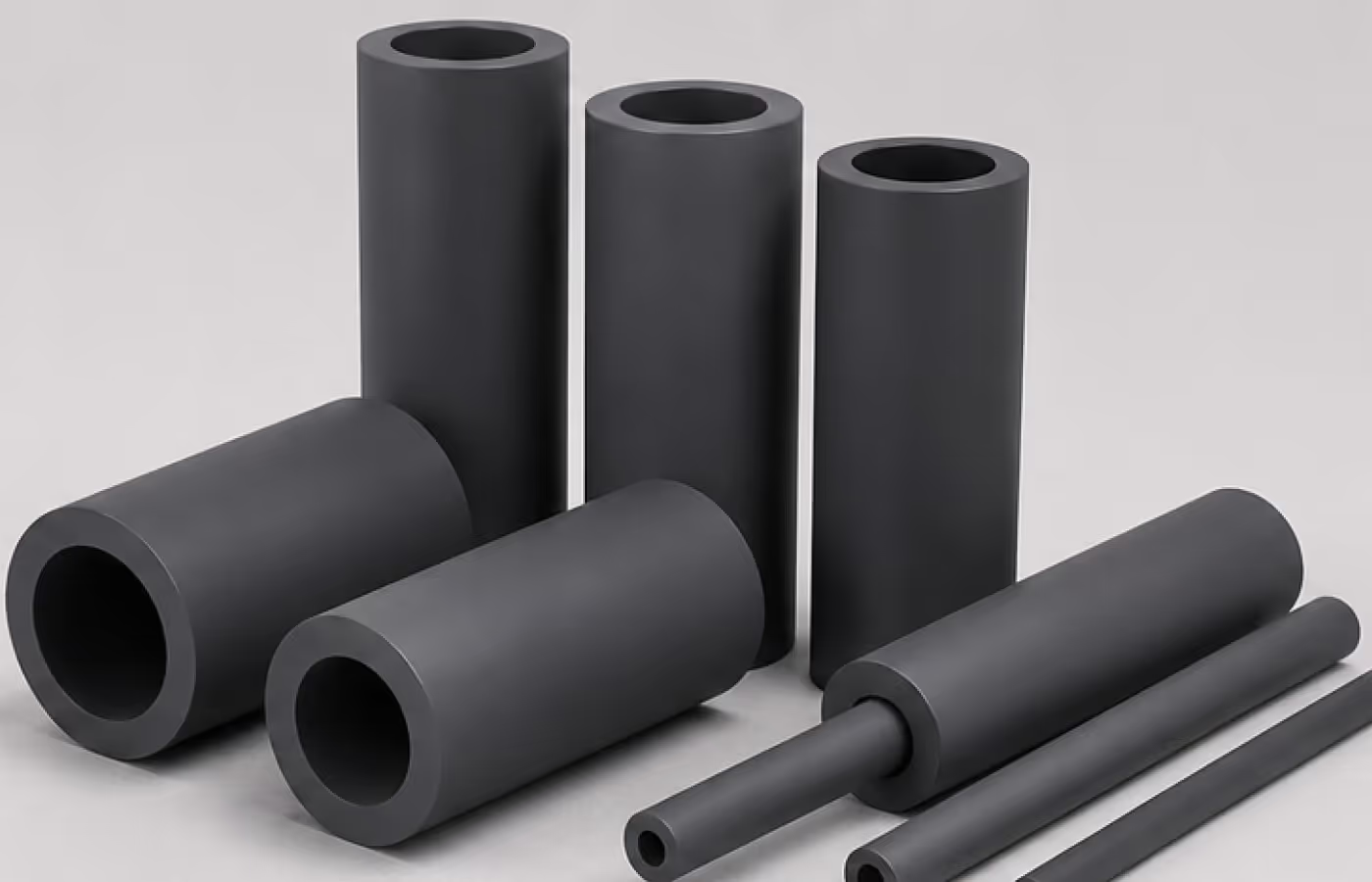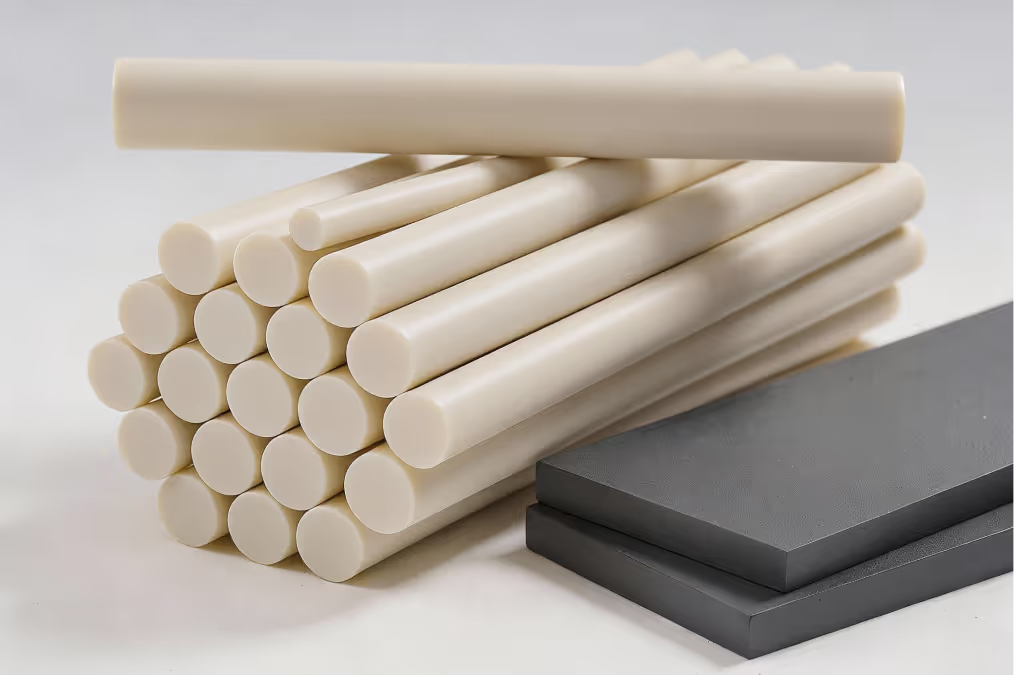
Most engineers evaluate a stock shape after machining. They check tolerances, surface finish, and dimensional accuracy. If the part holds up, the material gets approved. If it warps, cracks, or machines unpredictably, the blame falls on the machinist or the CNC setup.
But here is the truth: the quality of that machined part was largely determined before it ever reached the CNC.
Internal stress, porosity, inconsistent crystallinity, and contamination are all baked into a stock shape during manufacturing. A well-machined part made from a poorly manufactured stock shape will still fail. No amount of machining precision can correct for bad upstream process control.
This article breaks down the four upstream factors that separate a reliable stock shape from an unpredictable one — and explains how each one affects the parts you produce downstream.
Raw Material Sourcing: Why Prime Resin Matters
Every thermoplastic stock shape starts as resin pellets. The quality of those pellets determines the ceiling of what the finished shape can be.
Prime-grade resin is manufactured to a controlled molecular weight distribution, with consistent melt flow characteristics and no contamination. When you extrude from prime resin, you get predictable processing behavior and consistent mechanical properties throughout the shape.
Regrind and recycled blends tell a different story. Regrind introduces variability in molecular weight because the polymer chains have been thermally degraded through one or more previous heat cycles. Shorter, less uniform chains produce lower mechanical properties — lower tensile strength, reduced impact resistance, compromised fatigue performance. The degradation is not uniform, so properties vary unpredictably from batch to batch and even within a single rod or plate.
Recycled material also carries contamination risk. Trace amounts of other polymers, colorants, or degradation byproducts can form weak points, alter surface finish during machining, or cause unexpected chemical incompatibility in service.
At Quantum AEP, every material family — PEEK, PPS, Ultem, PVDF, and Delrin AF — is extruded exclusively from prime-grade resin. No regrind. No recycled blends. This is not a marketing claim. It is a process control requirement that we build into every production run.
Extrusion Control: The Foundation of Consistency
Extrusion is where resin becomes a stock shape. And the parameters used during extrusion — temperature profiles, screw speed, die design, cooling rates — have a direct and measurable impact on the properties of the finished shape.
Get the temperature profile wrong, and you introduce uneven crystallinity. Run the screw too fast, and you create shear-induced stress that cannot be fully eliminated by annealing. Cool the shape too quickly, and you lock in surface-to-core property gradients that will show up as dimensional instability during machining.
This is where modern process control makes a measurable difference. Quantum AEP's extrusion lines use Industry 4.0 monitoring and control systems that track temperature, pressure, screw torque, and line speed in real time. Deviations from target parameters trigger immediate correction. The result is tighter property consistency from the surface of a rod to its core, and from the first meter extruded to the last.
High-temperature optimized extrusion is particularly important for large-diameter rods and thick plates. These geometries have large thermal gradients between the outer surface and the core during processing. Without proper temperature control and cooling management, the core and surface crystallize at different rates — producing internal stresses that are difficult to fully relieve even with annealing.
AI-driven process intelligence takes this further. By analyzing process data across production runs, the system identifies correlations between process parameters and downstream quality metrics. It learns what parameter combinations produce the best outcomes and adjusts process windows over time. This is continuous improvement embedded in the manufacturing system, not dependent on individual operator experience.
Annealing: The Most Underrated Step in Stock Shape Manufacturing
If there is one process step that separates a good stock shape from a great one, it is annealing. And it is the step most commonly skipped or done inadequately by lower-tier producers.
Annealing is a controlled heat treatment applied after extrusion. Its purpose is to relieve the internal stresses that build up during the rapid cooling and solidification that follows extrusion. These stresses are unavoidable in the extrusion process — the question is whether they are properly relieved before the shape reaches the machine shop.
These internal stresses are invisible. You cannot see them on the surface. You cannot measure them with a caliper. But they are there, locked into the molecular structure of the shape. When a machinist begins removing material from a stressed shape, those stresses are released asymmetrically. The result: warping, unexpected dimensional change, and parts that hold tolerances on the machine but shift after they leave the fixture.
Proper annealing eliminates this problem. By slowly heating the stock shape to a controlled temperature and holding it there for a calibrated time, you allow the polymer chains to relax and the internal stress distribution to equalize. Slow, controlled cooling back to ambient temperature preserves the stress-relieved state.
Quantum AEP uses a proprietary annealing process calibrated for each material family and geometry. Different polymers require different annealing temperatures and hold times. A thick PEEK rod and a thin PEEK plate require different annealing protocols. Getting this right requires material-specific knowledge developed through process engineering, not guesswork.
Traceability and Inspection: Closing the Loop
Manufacturing discipline means nothing without documentation. If you cannot trace a batch back to its raw material source, extrusion parameters, and annealing records, you cannot investigate when a problem occurs — and you cannot demonstrate compliance when a customer requires it.
At Quantum AEP, each production batch is logged with its complete process history. Extrusion parameters, annealing cycles, incoming resin lot numbers, and inspection results are all captured and retained. When a customer receives material, that traceability travels with it.
This level of traceability supports quality audits, regulatory compliance, and internal material qualification programs. For customers in aerospace, semiconductor, or medical applications, where material qualification is a formal requirement, this documentation is not optional.
Standardized inspections at each stage — incoming resin verification, in-process monitoring, and final dimensional and visual inspection — create a closed-loop quality system. Defects are caught close to their source, not discovered after a machining run produces hundreds of rejected parts.
Why This Matters for Your Next Project
The difference between a good stock shape and a bad one is not always visible. Two rods can look identical on the shelf. They can have the same color, the same surface finish, the same diameter. One will machine predictably and hold tolerances. The other will spring after machining, produce inconsistent surface finishes, and fail earlier than expected under cyclic load.
The difference is in the process: what resin went in, how it was extruded, whether it was properly annealed, and whether the production data was captured and verified.
These are not premium extras. They are the baseline requirements for engineering-grade stock shapes used in demanding applications.
Our team can walk you through our manufacturing process and help you select the right grade for your application. Share your requirements and contact Quantum AEP to start the conversation.

.avif)
.avif)